Why should I care about the WMU-AAUP’s 2021 negotiations? Four core values at the heart of the struggle

As the WMU-AAUP finds itself in the midst of another contract negotiation cycle, all members have the opportunity to highlight our most fundamental values when talking with colleagues, students and other community members. They may already know that the WMU-AAUP fights hard for salary and benefits at the negotiating table, but be less aware of how other campus concerns show up on the Chapter’s agenda. Here’s a quick summary, then, for the next time you run into someone who’s not quite able to connect the dots between their daily professional burdens and battles and the hard work of our negotiating team.

Foundational WMU-AAUP values and concerns:

  • Shared governance: faculty are primary stakeholders at WMU; we must be consulted, as directed and implied by the Agreement, and ought to be consulted on other matters likely to impact WMU’s campus community; important decisions made by WMU admin without consultation with the Chapter are of legitimate concern to our members
  • Working conditions: the requirements and demands made upon faculty time, as well as the campus climate, are of central interest to members, for example, fair and equitable workload, as well as large-scale administrative initiatives (e.g., general education overhaul or program review), and campus climate issues such as harassment and bullying
  • Academic freedom: the ability to explore, discuss, disseminate, and teach without fear of interference or reprisal is critical; examples of issues associated with this value might be: WMU’s use of faculty activity reporting, workload reports, and student evaluations; the shift away from tenure-track positions and increasing reliance on temporary instructional labor (e.g., part-time and term colleagues); administrative monitoring or undue scrutiny of faculty expression in, for example, syllabi, blogs, social media, or the classroom
  • Fair and equitable compensation and robust benefits: Fairly compensated, tenure-track faculty positions with competitive benefits packages ought to be among WMU’s very highest priorities; in general, the prioritization of people and resources central to WMU’s core academic mission as a research-intensive university are to be highlighted

Thank you for having the WMU-AAUP’s core values close at hand the next time someone wonders about the purpose or efficacy of our collective bargaining unit. The briefest response may simply be that the WMU-AAUP stands for what is best about higher education: research and creative activity, student success, and the dignity and viability of the professional lives at the heart of the academic mission. Together we are stronger!

What will it take for WMU to drop its “financial emergency” rhetoric?

A message from the WMU-AAUP President and Vice President

Given the brutal year that WMU professors have had, you might imagine that WMU would be approaching ongoing negotiations with the WMU-AAUP with a renewed spirit of compassion and moderation. After all, when the pandemic crisis hit, WMU professors leapt to answer the call for shared sacrifice. We scrambled to move our courses online, to care for traumatized students, and even to donate part of our salaries to offset a “financial emergency” projected by administration that never materialized. As unmanageable teaching and service loads proliferated, marginalizing scholarship and research, faculty rose to the occasion again and again.

Many faculty members, some at the pinnacle of their careers, even went so far as to accept early retirement incentives to free up resources that WMU insisted it so desperately needed. Some professors, to be sure, have been consistently skeptical of the university’s intentions. Others, however, believed that, as the pandemic crisis began to ease, and financial exigency claims became even more implausible, WMU would be motivated to recommit to academics and to restore collaborative and respectful partnership with faculty.

Unfortunately, although WMU-AAUP negotiations are still in the early phases, WMU seems to be heading down a path with built-in expectations for ongoing sacrifice by the faculty, and the many other WMU workers whose terms of employment are shaped by the WMU-AAUP Agreement. Some early signs suggest that WMU would like to extend the “pandemic emergency” narrative indefinitely into the future, thereby justifying ongoing sacrifices that WMU employees have rightly identified as unnecessary, unwise, and unfair.

To put things in perspective, what’s happening at WMU has been happening all over the nation as emboldened administrators have sought to make permanent changes by leveraging and extending the momentum of pandemic fear and chaos. As described in a recent AAUP national report, “COVID-19 served as an accelerant, turning the gradual erosion of shared governance on some campuses into a landslide.” The full report is here.

Instead of acknowledging and rewarding faculty labor and sacrifice, such institutions seem determined to squeeze employees as hard as possible. Fortunately, at WMU and at many other institutions, faculty have adapted to the new reality. We are emerging from the pandemic fog and, once again, doing what we do best: focusing on empirical facts and rational arguments. For example, as confirmed by an outside analyst, and even before the stunning $550 million donation, WMU’s own records have consistently demonstrated its financial health, and we are empowered by knowledge such as this. In addition, we faculty members understand that any ongoing erosion or disinvestment in academics will be a gut punch, not just to the professoriate, but to the basic viability of the university.

What’s happening at the negotiation table is about so much more than faculty salary, benefits, and working conditions, then. It is a fight for the identity of the university as it will exist in the post-pandemic future. With this in mind, we continue to hope that WMU will become more focused on collaborating with its employees to strengthen and rebuild our academic core and less intent on “winning.” To be sure, our exceptionally well-prepared and determined negotiation team is entirely up to the task. But we can’t help but imagine how much better things would be for everyone if WMU committed to treating faculty members as partners rather than adversaries.


Dr. Cathryn Bailey, WMU-AAUP President
Dr. Natalio Ohanna, WMU-AAUP Vice President

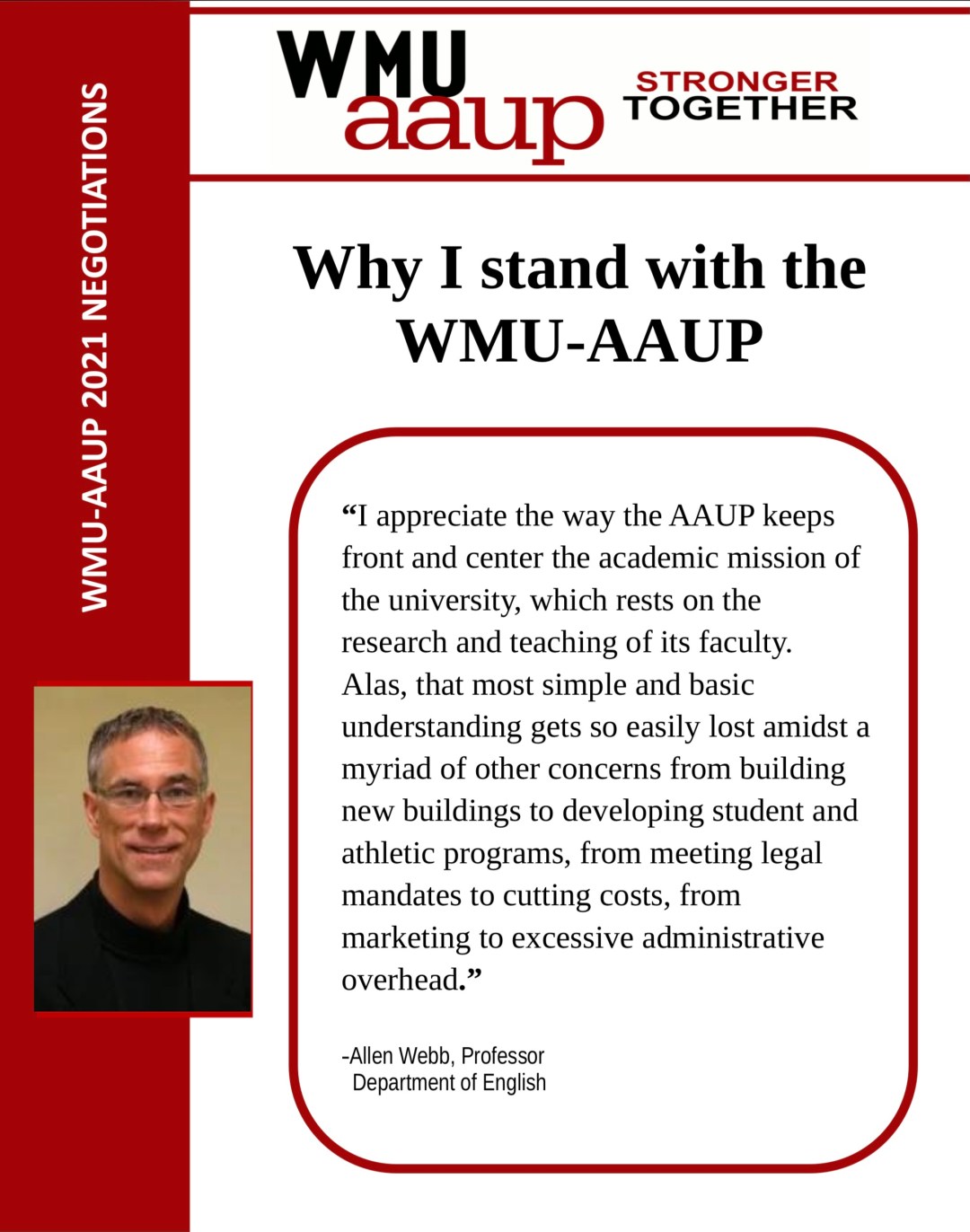
WMU faculty experiences and perspectives: Can we quote you?

WMU faculty have rarely been shy when it comes to expressing their preferences, insights, point of view, or simply sharing their experiences. But in the past year, faculty have been unusually forthcoming, and through many and various modalities, for example:

  • WMU-AAUP surveys, for example, about workload concerns
  • official Chapter referendums on particular issues, for example, about the administration’s academic restructuring plan and pandemic safety
  • official Chapter votes, for instance, in the election for WMU-AAUP President and Vice President
  • scores of emails to the Chapter, many with wrenching accounts of workload violations and other abuses
  • poignant testimonies, sometimes tear-filled, at WMU-AAUP meetings, especially about careers and lives damaged during the university’s pandemic response this past year

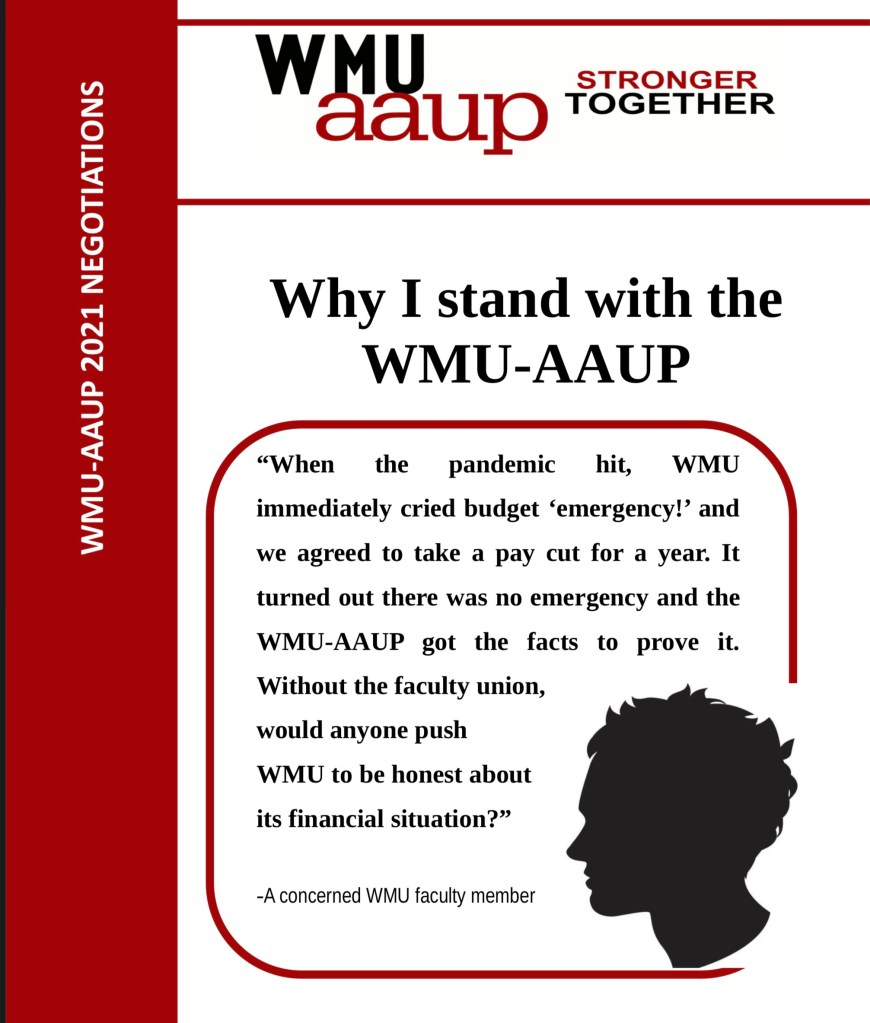
As we proceed through what is shaping up to be a challenging negotiation process, your ongoing generosity with your thoughts and experiences matters more than ever. If you feel moved to do so, then, please take a few moments to tell us about your experiences or perspective (staff@wmuaaup.net) either specifying your wish to remain anonymous or with permission to use your name. Whether you’re describing challenges you’re facing, your reasons for supporting the WMU-AAUP, or your love for our university, we want to hear from you. While we won’t be able to feature all faculty submissions in graphics like those contained in this post — to be circulated in social media and through other means — each faculty voice will help us continue to build a picture of the challenges we’re facing and the strengths that will see us through them.

When WMU faculty voices are dismissed…

The WMU-AAUP has taken many steps to ensure that its initiatives and statements are rooted in the will of its members. First, we have used numerous surveys, polls, and votes. The results have been impressive, including in the November election for Chapter President and Vice President — with very high numbers of participation — and, on a number of key issues, remarkably univocal. In addition, at all-member Chapter meetings, and meetings of the Association Council (department reps), and in countless emails and one-on-one meetings, WMU faculty have spoken out in unusual numbers and with extraordinary candor.

To be sure, no organization can satisfy the wishes of all its members and there’s no use pretending otherwise. But it’s also good to keep in mind that a classic divide-and-conquer strategy used against those engaged in collective action is to question the basic legitimacy of the group expressing concerns. Far too often, here’s what happens: Instead of listening to repeated worries, suggestions, and complaints expressed by campus community members, including faculty, administrators insist that such expressions are those of a “radical fringe” and don’t represent a supposed “silent majority.” No matter how many voices speak up, nor how loudly or reasonably — including through damningly direct performance evaluations — administrators may continue to justify actions and policies by effectively dismissing whole swathes of the campus community as disgruntled, whiny, or difficult. Such administrators may be listening to some faculty voices, of course, especially those that consistently, and sometimes publicly, celebrate and applaud them.

It is frustrating and dangerous when such dismissive and trivializing strategies are used against any group, but it is especially pernicious when it happens during negotiations, and when the group in question is a legally recognized collective bargaining unit, the official voice of its members. As we have all seen in recent years, tirelessly spreading rumors that cast doubt on the legitimacy of elections, polls, and properly collected qualitative data is a tactic employed by those desperate to believe they are right. No matter what. It is precisely because of such stubbornness and wishful thinking that the WMU-AAUP, including the individual voices of its members, must continue to speak up. This is especially important now, as we are in the midst of negotiations, fighting not just for faculty salaries and decent benefits, but for the ongoing viability and dignity of the professoriate.

During negotiations, the WMU-AAUP will be finding new ways to share members’ experiences and messages of concern, then, for example, in graphics like the one below. Please contact us at staff@wmuaaup.net if you have experiences you’d like the Chapter to consider highlighting in these campaigns.

Imagining a New Deal for Higher Education

A vision for a more equitable and sustainable future.
By Lisa Levenstein and Jennifer Mittelstadt

(in the Spring 2021 issue of Academe, published by the AAUP)

In March 2020, when the COVID-19 pandemic hit the United States and upended colleges and universities, students scrambled to pack up dorms and apartments while faculty abandoned their offices and frantically moved labs and lectures to Zoom. Meanwhile, a burgeoning financial crisis in higher education was on the horizon. Locked in our homes, we learned that colleges and universities were losing money as students demanded refunds on housing and summer enrollments declined. COVID-19 was also affecting state legislatures, which would be hard-pressed to sustain prepandemic levels of funding.

By late March, members of Congress acknowledged but failed to stem the mounting crisis. The Coronavirus Aid, Relief, and Economic Security Act provided $14 billion to colleges and universities, $10 billion less than it provided to the airline industry, which employs only one-sixth of the workers found in higher education. Lacking substantial government support, college and university administrators began to unleash a tidal wave of cuts while maintaining tuition at historically unprecedented highs even as students and their families lost the ability to pay bills. By the end of June, more than two hundred institutions had implemented layoffs, furloughed employees, or failed to renew contracts—affecting more than fifty thousand employees. At the City University of New York, one of the largest public higher education systems in the nation, 2,800 adjunct faculty members lost their jobs.

(Continue reading at the AAUP’s Academe site)

Taking stock of WMU academic labor relations

a message from the WMU-AAUP President and Vice President

Dear Colleagues,
Almost nine months ago, we reached out to you as candidates for WMU-AAUP President and Vice President. With faculty labor being exploited, and faculty input being all but ignored, we asked you to stand with us to advance goals and values aimed at restoring shared governance. After being elected by overwhelming numbers in November, taking office in January, and completing our first semester as your Chapter leaders, we are now in a position to both take stock and also share some new concerns with you.

To begin with, we are confident that having new Chapter leadership in place is bringing about positive change with respect to WMU-AAUP and campus dynamics. The Chapter has stepped up efforts to take direction from members; adopted a collaborative, but skeptical, approach to administrators; increased its emphasis on building partnerships across campus; and embraced the fundamental AAUP values on which our organization was founded. Our focus is on academic freedom, shared governance, equity, and the protection of contractual due process.

In recent months, then, your WMU-AAUP has been more engaged, more assertive, and more vocal. Unsurprisingly, the Chapter has also been facing a backlash. Against the backdrop of pandemic fear and confusion, WMU seems now to imagine a compliant faculty happy to make endless sacrifices. As many of you have reported, there seems to be a greater expectation that professors should simply obey, sometimes with little regard for the Contract, Departmental Policy Statements, or even considerations of basic fairness.

Unfortunately, as the WMU-AAUP has become more proactive in defending members’ rights, we are experiencing instances of administrative stonewalling, delay, and apparent attempts to marginalize and intimidate us. To take an especially bold example, last month, WMU invented a new hybrid faculty-administrator position titled “Interim Associate Director of Academic Labor Relations.” WMU then appointed the previous WMU-AAUP Grievance Officer to the post just weeks after he had resigned his position with the Chapter. WMU has effectively moved him from one side of the table to the other while nominally preserving his faculty status.

The impact of unprecedented administrative stunts of this sort is, predictably, chilling for faculty members involved in, or contemplating pursuing, contractual processes or concerns. The situation is exacerbated by the fact that WMU is engaged in such maneuvers while repeatedly and summarily dismissing substantive and credible faculty concerns, complaints, and grievances. Again, there seems to be a worsening pattern in which WMU Academic Labor Relations is reluctant to collaborate consistently with the WMU-AAUP in good faith.

To be sure, we will continue to use all the tools at our disposal to address overreach and abuse while remaining open to opportunities for collaboration with our administrative colleagues. But the most powerful recourse we have is, of course, rooted in the faculty’s determination, knowledge, and unity. We share this message with you, then, as a sign of new possibility. After all, if the WMU administration is busy devising new strategies to distract the faculty or dismiss our voices, this is a sure sign that they know we are a force to be reckoned with.

In solidarity,
Cathryn Bailey, President of the WMU-AAUP
Natalio Ohanna, Vice President of the WMU-AAUP

This message was originally shared with WMU-AAUP faculty by email on May 18, 2021.

Talking with new faculty: What does the WMU-AAUP do anyway?

Though departmental and disciplinary cultures vary, one thing most faculty new to WMU share is a lack of clarity about what our faculty union is and how it impacts campus life. This is partly because the WMU-AAUP is an unusually vigorous, well-established, well-organized faculty collective bargaining unit when compared to those that may exist at other colleges and universities. With that in mind, here’s a brief summary that might to help us respond to new colleagues’ questions:

What does the WMU-AAUP do for faculty here at Western?

Because the WMU-AAUP can focus and harness the power of the entire body of Board-appointed WMU faculty, we are a formidable advocate for colleagues in countless ways. In many situations, the WMU-AAUP is the only line of defense between a faculty member and the considerable might of the WMU administration.

A few examples of what we do:

  • push for salary increases, reasonable healthcare costs, and many other benefits, through the grueling contract negotiation process
  • support individual faculty who believe they’ve been treated unfairly and/or in ways that violate the WMU-AAUP Agreement
  • hold regular workshops to help faculty colleagues succeed through the promotion and tenure process
  • exert a powerful influence in WMU’s culture of shared governance through our participation on key committees, as well as ongoing formal and informal conversations with administrators

How can new colleagues best support the union?

  • sign and submit your dues card, and join the over 90% of WMU faculty who’ve already done so; this will ensure your access to all WMU-AAUP faculty services
  • attend our Faculty Barbecue on Sept. 5th at Montague House
  • attend our New Faculty Luncheon on September 20 with your department’s AAUP representative (Association Council member)
  • attend the all-Chapter meetings held each semester and offer your input
  • follow the WMU-AAUP on this blog, our enews, Facebook, and Twitter, and visit the WMU-AAUP’s website for quick access to critical resources
  • stop by our regularly scheduled morning coffees and happy hours (dates announced in our emailed enews)
  • stop by and see us at Montague House! we love to meet our new (and longtime!) colleagues

What’s the mission of the AAUP in general?

“The mission of the American Association of University Professors (AAUP) is to advance academic freedom and shared governance; to define fundamental professional values and standards for higher education; to promote the economic security of faculty, academic professionals, graduate students, post‐doctoral fellows, and all those engaged in teaching and research in higher education; to help the higher education community organize to make our goals a reality; and to ensure higher education’s contribution to the common good. Founded in 1915, the AAUP has helped to shape American higher education by developing the standards and procedures that maintain quality in education and academic freedom in this country’s colleges and universities.”

2021 Negotiations begin!

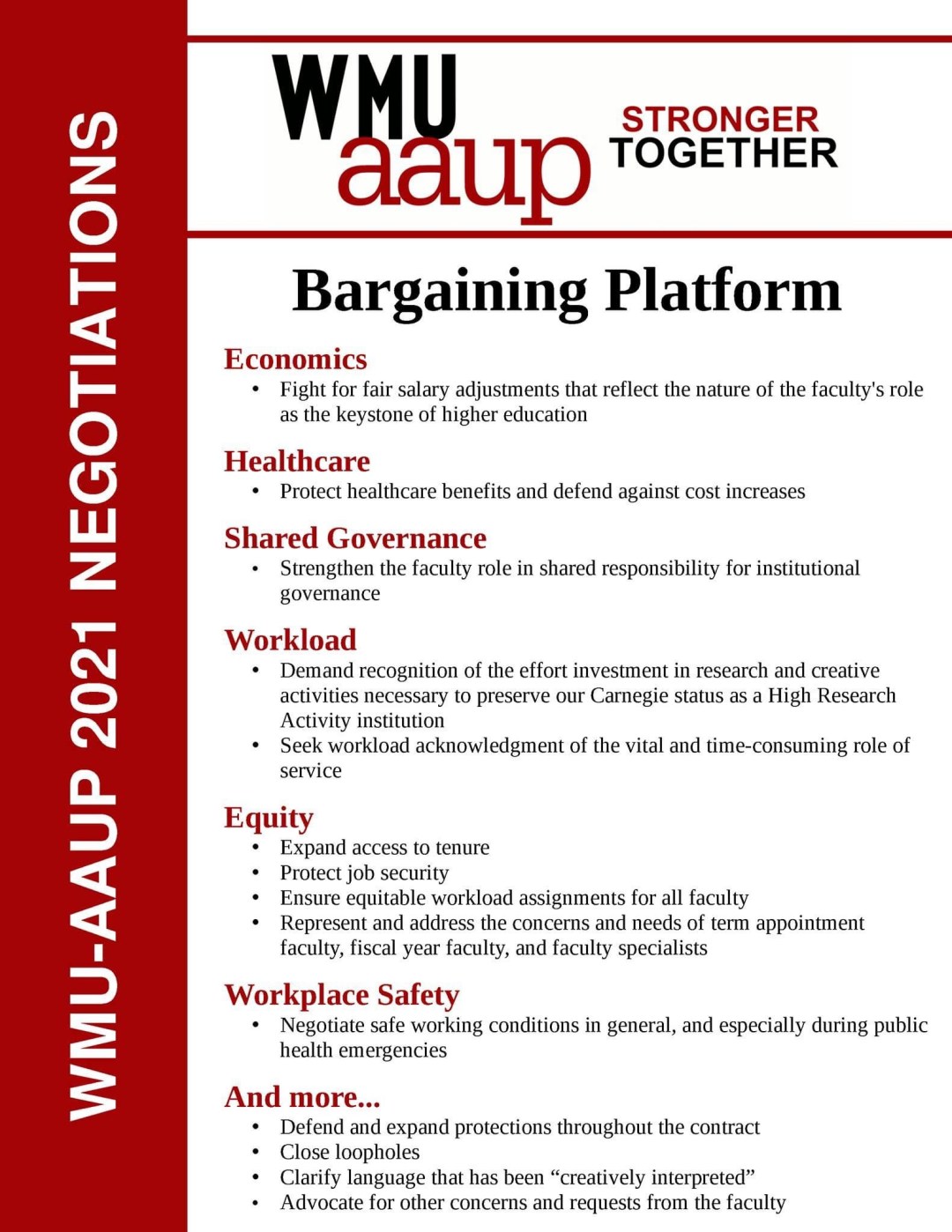
WMU-AAUP contract negotiations officially began Thursday, May 13. As you may know, our exceptionally hardworking negotiation team members — Whitney Decamp (Chief), Charles Crawford, Regina Garza Mitchell, and Robert White — bring considerable experience and expertise to the process. They are well prepared, and eager to bring faculty priorities to the bargaining table.

The Chapter will provide ongoing negotiation updates. We will also be in touch about how members and allies can support this process to help ensure that we have a successful outcome. This is a critical moment to recall that our strength is in our unity and that the terms of the WMU-AAUP Contract have implications for nearly every other WMU employee group. Whether you are a member or an ally, please share the bargaining platform widely to demonstrate your support for our team, our union, and our university.

How successful are we at WMU at expressing our research-intensive values?

How many undergraduate students know the difference between a research-intensive university and one that is overwhelmingly teaching-focused? Even if students can recite some of the differences, how many of them even care? Further, to what extent are faculty members in touch with the reality of how well our university actually measures up to the values and mission associated with being research-intensive?

At universities like WMU that identify and market themselves as both research-intensive and focused on undergraduate education, these may be especially important issues to grapple with. After all, if we, ourselves, are not clear about how well our institution fulfills its claims to be research-intensive, we can’t help students appreciate this quality. As we reflect, then, here are a few reminders of some criteria generally associated with being research-intensive.

Such universities:

  • invest in faculty scholars and researchers, providing workloads, facilities and other resources (e.g., library, equipment, grant preparation, and travel funding) that facilitate and nourish such activity
  • place a high value on attracting and supporting promising graduate students across a broad range of disciplines; while such students may directly contribute to the teaching mission, their identities as scholars is primary
  • facilitate and encourage individual faculty efforts to incorporate their research into their teaching by, for example, providing grants and release time
  • foster and maintain specialized undergraduate majors and internships, instead of supporting only the most popular, fashionable ones
  • eliminate institutional roadblocks that impede interdisciplinary collaboration, for example, team-teaching or joint research projects

When considering our university, how would you respond to these questions? What other criteria are critical for assessing a university’s designation as research-intensive in ways that might matter most to faculty and students? And what other questions should we be considering when we ponder the future identity of our university as research or teaching-focused?

WMU without the WMU-AAUP? What a difference academic collective bargaining makes!

After more than four decades of living and working in the reassuring presence of a well-crafted, comprehensive, mature contract, it’s easy to become complacent about the guarantees and protections that have come to shape WMU’s campus life. And, to be clear, though the WMU-AAUP Agreement has been forged specifically between WMU and the WMU Board-appointed faculty, this foundational document impacts our entire campus culture. In short, the power of WMU’s professoriate to bargain for fair wages, decent benefits, and shared governance has led to the creation of a campus community that is far more transparent, democratic, and humane than it might otherwise be.

Because it is far too easy to forget what it used be like, consider the routine risks of living and working on a campus with no formal collective bargaining power:

  • compensation and benefit structures that may be decided on arbitrary, or so-called “market based” criteria, with little hope of predictable raises, or of avoiding drastic healthcare insurance increases;
  • tenure and promotion procedures that are opaque and draconian and that may include no formal avenues for appeal or challenge;
  • the power to summarily eliminate departments and faculty positions according to economic vicissitudes and administrative whims;
  • unchecked disciplinary procedures according to which administrators might determine a faculty member’s guilt and assign penalties with no provisions for due process;
  • a climate in which all mid and higher level decisions may be made by admin, including those with direct implications for academics, with little or no input from faculty

In short, before there was the WMU-AAUP, life here was a lot like it is at other non-unionized campuses at which faculty members function as laborers serving at the pleasure of management. Even an occasional, cursory glance at national higher education news makes clear that faculty colleagues at many other campuses live in a shadow of fear and uncertainty that impacts their wages, capacity to exercise academic freedom, and, yes, their mental health. The fact that many of us at WMU may no longer feel moved to actively celebrate the rights and advantages we have earned through our collective power is perhaps the greatest testament to the WMU-AAUP’s astonishing success over the decades.

And, again, though not all campus employee groups share equally in these advantages, the positive impact of the WMU-AAUP on the entire campus is evident, including:

  • a tendency for enhanced wage and benefits for many non-faculty employees, given how the WMU-AAUP’s negotiated wage and benefits packages influence subsequent agreements made with other employee groups;
  • a campus at which other employees are more likely to feel supported as they embrace their right to organize, for example, AFSCME, PSOA, POA, MSEA, IATSE, TAU, and the PIO, all further ensuring a healthy check and balance on unrestricted administrative power at WMU;
  • a climate of shared governance according to which there is precedent for employee demands of participation and transparency, an environment in which employees’ right to ask questions and expect answers becomes more normalized and likely

Though it may be true that the WMU-AAUP’s consistent success and effectiveness tempt us to take it for granted, as we prepare now for 2020 negotiations, it’s the perfect time to imagine life at WMU without our faculty union. In fact, we don’t have to tax our imaginations at all if we simply invite the perspective of longtime WMU faculty members, including one retired early WMU-AAUP leader who is eager to share cautionary anecdotes with all who will listen. “We were completely at their mercy,” he recalls, “and the only real leverage we had when we knew we were being treated unfairly was to quit our jobs, pack up our families, and leave.”