WMU Leaders’ Response to the No-Confidence Vote: “We know better than you.”

A message from Cathryn Bailey and Whitney DeCamp, WMU-AAUP President and Vice President

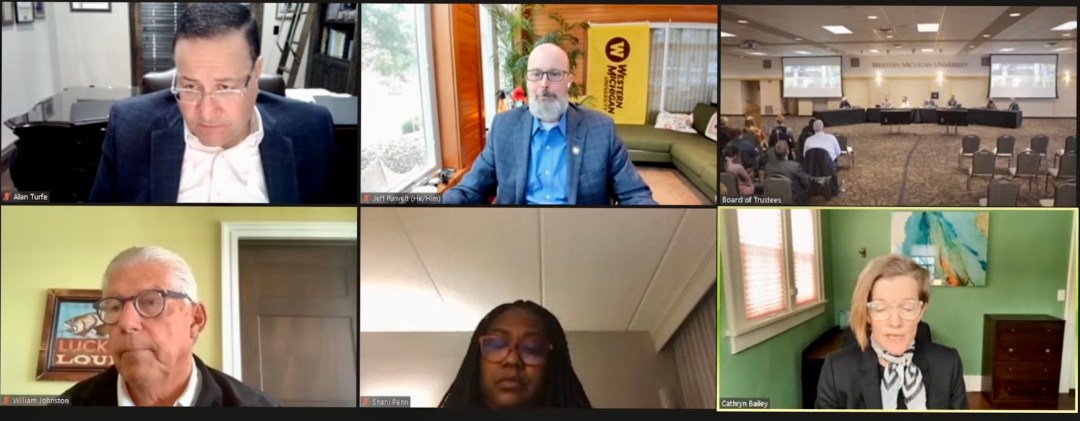
If you attend Western Michigan University Board of Trustees public meetings, you may have noticed that these seem intended to create an aura of optimism about all things Bronco. To step into this meeting space can sometimes feel like entering an alternate universe. And at the Jan. 20th Board meeting, the air of unreality was especially dramatic, with nearly all agenda items focused on institutional self-congratulation. As the meeting entered its second hour, there was even a lengthy “WMU-in-the-news” retrospective, a narrated highlight reel of 2021 that somehow managed to overlook the previous year’s headlines about Western’s heavy-handed negotiation tactics with its own employees, its stunning enrollment declines, and the historic No-Confidence Vote in its president.

Such paint-it-pink and put-a-bow-on-it tactics are also consistent with WMU’s handling of President Montgomery’s performance reviews. Despite repeated calls that these documents be shared, including separate Freedom of Information Act requests presented to WMU from the Western Herald and Mlive, Western is keeping these documents under wraps. The facts surrounding the president’s job performance, whom our university compensates like an elite corporate CEO, are obscured behind a painstakingly constructed public performance featuring smiley faces and rainbows.

While there is surely much to celebrate at WMU — our students, colleagues, and community partners deserve to be applauded — at the Jan. 20th Board meeting, only the speakers relegated to the tail end of the meeting — the “public comments” section — reflected on Western’s problems, some of which are glaringly obvious. And among those speakers tacked on to the meeting’s end were WMU’s three academic labor leaders, the presidents of the Teaching Assistants’ Union (TAU), the Professional Instructors Organization (PIO), and the WMU-AAUP, with the PIO and TAU presidents also having also spoken up at the Board’s previous meeting. The very fact that the groups that make WMU an academic institution have been pushed to the meeting’s tail end, and with strict time limits of just a few minutes each, speaks volumes about the purpose of these meetings.

In addition, the responses of President Montgomery and the Board Chair to the feedback presented to them at this meeting were also telling: Those critical of Western’s leaders are naive and resistant to change, unable to comprehend the profound impact of the pandemic on contemporary higher education. WMU’s leaders, however, have the requisite wisdom, experience, and business acumen to forge ahead even in the face of vocal popular resistance. Of course, the reality is that constituents’ objections are not to thoughtful and necessary change, but to top-down decrees and stony silence instead of collaboration and understanding.

It’s important to recall that one of the specific critiques expressed in the historic Vote of No Confidence is this president’s “unwillingness to engage with or consult with faculty in meaningful ways and respond appropriately to feedback and concerns.” It is bad enough, then, that leadership has had over a month to consider this stunning Resolution, and the damning Faculty Senate evaluation that preceded it, yet continues to marginalize campus and community concerns. But to wave away thoughtful feedback as a symptom of ignorance, naivety, and resistance to change is an especially callous silencing tactic. Western students, faculty, staff, and community members have both the right and responsibility to continue to demand and expect better.

Some possibilities for remaining involved as this situation continues to unfold:

– Reach out personally to colleagues and community members to make sure they are fully informed about the No-Confidence Vote, including the process that led to it, the facts surrounding it, and the commitment it demonstrates to our students and university.

– Follow the WMU-AAUP blog and actively share items about the No-Confidence Resolution on Facebook, Twitter, etc. Consider directing your posts by using the @WesternMichU, @AAUP, @mlive, etc.

– Submit a comment to the Board of Trustees through their website respectfully sharing your questions and concerns.

– To the degree that it is feasible for you, initiate dialogue with chairs, deans, and other administrators to help them understand your concern for our students and university, and the nature and implications of the No-Confidence Resolution.

– Share news stories related to the No-Confidence Resolution with colleagues and on social media and consider submitting comments or letters to the editor at, for example, letters@kalmazoogazette.com or kznews@mlive.com or to the Western Herald).

– Consider meeting with President Montgomery during his office hours to engage in respectful dialogue about your concerns; appointments available here. There are a limited number of these 20-minute appointments (five per week), so you may need to book a week or two in advance.
When students, staff, and faculty become invisible to WMU leaders

Remarks delivered by WMU-AAUP president Cathryn Bailey to the Board of Trustees at its January 20th meeting. View the recorded meeting segment here. A link to the full meeting is here.

My name is Cathryn Bailey and I am here in my role as President of the WMU-AAUP. For those unfamiliar, the WMU-AAUP is the legally recognized collective bargaining unit for Western’s board-appointed faculty. We, the faculty, are respectful and powerful partners at Western Michigan University, and many of us are career-long Broncos. So it was stunning when, during the week of Dec. 10, WMU professors voted in decisive numbers to issue a Resolution of No Confidence in the university’s president.

Unfortunately, as one symptom of the growing crisis that led to this Vote of No Confidence, I am entirely aware that everything I say right now may be dismissed as the words of a naive or disgruntled faculty member. Indeed, I watched at the December Board of Trustees meeting as the thoughtful and impassioned words of the President of the Professional Instructors Organization, the President of the Teaching Assistants’ Union, as well as one of my esteemed faculty colleagues, were met with silence.

So, what recourse do we students, faculty, and staff have after we’ve sounded alarm bells for years, warning that the ship has been taking on water and is sailing in the wrong direction? We campus and local community members attend these kinds of meetings month after month as spectators, but when we raise our voices to name real problems that cannot be addressed by more boosterism or cheerleading, we discover, once again, that we have become invisible to our own leaders. It was in this climate of invisibility and dismissal that WMU faculty voted overwhelmingly in favor of the Resolution of No Confidence last month.

Even so, however, despite frustrating years of feeling unheard, my faculty colleagues debated and deliberated about the No Confidence initiative at length. In fact, for most of last semester, we argued in groups large and small about how best to call attention to the increasingly desperate plight of our beloved university. Finally, on Dec. 10, faculty voted to hold an official No-Confidence Vote in WMU’s President and ballots were sent to all members. The results were certified on Dec. 17 with nearly 80% of respondents voting in support. These results are spectacular given the short response time for the vote, that it was conducted at one of the busiest time for professors, and the fact that an impressive majority of the faculty chose to participate.

As a reminder, and as expressed in the No Confidence Resolution, among the problems we’ve identified include:

-significant declines in WMU’s enrollment and national rankings that are much worse than that of similar Michigan institutions;

-a stunning decline in faculty and staff morale rooted in unjustifiable and irresponsible staffing shortages and a disregard for student, staff, and faculty voices;

-an expensive top-down rebranding initiative that has brought negative national attention to WMU, further endangering the value of our students’ degrees; and

– a failure to properly prioritize and resource WMU’s academic mission and infrastructure; it’s almost as if, at Western Michigan University, teaching, learning, and advising have become an afterthought.

Much greater detail about these evidence-based concerns was included in the WMU-AAUP Executive Committee’s letter to the Board last week which can be reviewed at http://www.theWMUAAUP.com.

However, despite the fact that the No Confidence Resolution is rooted in facts and solid reasoning, at the December Board of Trustees meeting, it was explicitly stated that the Board members were “well aware” of the No-Confidence Vote as the Board went on to authorize a $75,000 “merit bonus” and a more than $7,000 raise to the president’s annual base salary retroactive to July 1.

If Western continues on this downward spiral, making excuses for its extravagantly compensated high level administrators, what will our university look like in three, five, or ten years? What will our students’ degrees be worth and how will we attract new talent and energy? WMU students, staff, faculty — and even the majority of WMU administrators — all know that we need dedicated, self-reflective, academically-focused leadership to renew the trust students and their families have placed in this university. In fact, I would encourage anyone here who is still ignoring this wake-up call to invite students, staff, and administrators to participate in a No Confidence Vote as well. How many Western students, staff, and administrators believe that WMU is being led effectively?

What we are respectfully requesting from our Board of Trustees here today, then, is that you consider hard truths and use your power to initiate real change. At its December meeting, one Trustee firmly stated that the Board “stands with its president.” But who is standing with the staff, faculty, students, and Michigan families who have placed their futures in your care? For us all to stand together today and tell the truth about our university’s problems, including the failures and weaknesses of its higher administration, is not disloyal or negative, it is the most loving and constructive step we could take.

Let’s take that step together.

No Confidence in WMU’s President: A Letter to the Board of Trustees from the WMU-AAUP

Please see this important letter to WMU’s Board of Trustees from the WMU-AAUP Executive Committee regarding the WMU-AAUP’s Resolution of No Confidence in President Montgomery.

Please also mark your calendars for the next Board of Trustees meeting (Thursday, January 20, at 11 a.m.) when WMU-AAUP President Cathryn Bailey will deliver a message about the No Confidence Resolution. Given both ongoing and newly urgent concerns about public health, we encourage you to watch the live stream from a safe location (link available on the Board’s webpage). If you can’t attend live, note that recordings of Board meetings are usually made available through the same link. Please remain engaged in this historic process — continue to share your concerns and expectations widely —while also protecting your health and that of our community.

WMU Faculty Have Spoken: No Confidence in President Montgomery

A message from WMU-AAUP President, Dr. Cathryn Bailey

Last Friday, at a special all-member Chapter meeting mandated by the Association Council (WMU-AAUP department representatives), faculty voted to hold an official No-Confidence Vote in President Edward Montgomery. Since then, members have had the opportunity to vote electronically on the resolution and the results have now been certified: In decisive numbers – 78% of respondents in support — faculty from across Western Michigan University have expressed No Confidence in the leadership of President Edward Montgomery. These results are all the more striking given the short response time for the poll – just one week – and the fact that an impressive majority of the faculty (439) chose to participate.

To be clear, WMU professors have taken this historically rare step only after much research, robust discussion, and somber reflection. In fact, it is largely because of this president’s jarring lack of responsiveness to urgent constituent concerns and his consistently weak presence in our campus community that faculty have felt the need to take such action. In short, the Western Michigan University Chapter of the American Association of University Professors issues this Resolution of No-Confidence in President Edward Montgomery because we believe this president has thus far shown himself unwilling to address the challenges WMU faces.

The process that has led us here has been patient and painstaking. Specifically, at WMU-AAUP meetings held over the past several months (of both the full Chapter and the Association Council), a volunteer faculty working group that has included members from all but one of WMU’s academic colleges has presented documented concerns relevant to the university’s ongoing viability, for example:

– continuing dramatic drops in enrollment even as some similar Michigan institutions have begun to boast impressive enrollment increases

-a significant decline in WMU’s national rankings that coincides with the current president’s time in office, a decline much worse than that of similar Michigan institutions

-a precipitous decline in faculty and staff morale at least partly attributable to unjustifiable and irresponsible staffing shortages and unreasonable faculty workloads

-an expensive top-down rebranding initiative that has brought negative national attention to WMU, further eroding Western’s reputation and endangering the value of students’ degrees

– failure to properly prioritize and resource WMU’s academic mission and infrastructure

All the while, President Montgomery has remained largely unresponsive to such urgent concerns, and has, instead, engaged in vigorous public defenses of his job performance. Stunningly, even in the wake of dramatically low approval ratings on a recent evaluation conducted by the Faculty Senate (see image below), the president has continued to suggest that faculty are misguided in their feedback on his performance.

It is important to convey that faculty have undertaken consideration of a Resolution of No-Confidence in President Edward Montgomery with extraordinary seriousness, care, and conscientiousness. Nonetheless, at their meeting just yesterday, WMU’s Board of Trustees seemed to dismiss the faculty initiative, stating that the Board was “well aware” of the No-Confidence Vote, and insisting that, regardless, they “stand behind our president.” Despite the rising tide of evidence-based criticisms from across campus, the Board also authorized a $75,000 “merit bonus” and a $7,290 raise to his annual base salary retroactive to July 1. Make no mistake, though, this sort of trivialization and dismissal of faculty, student, and staff voices only strengthens our resolve to speak publicly about this president’s failed leadership.

At the many meetings and discussions leading to this grave moment in WMU history, faculty have been utterly clear both about our love for our students, our university, and our community, and about our frustration and grief about the path WMU is on. If Western continues on this downward spiral, what will our beloved university look like in three, five, or ten years? WMU faculty know that, with dedicated, self-reflective, academically-focused leaders, WMU might once again become a point of pride for Kalamazoo and Western Michigan, renewing the trust students and their families have placed in this institution. This Resolution of No-Confidence is a call for an urgent course correction, one informed by the intelligence, heart, and experience of the students, faculty, and staff for whom this great university is so much more than a job or a line on their resume.

Special Dec. 10th All-Member Meeting

WMU-AAUP Membership Considers Vote of No Confidence in University Leadership

On Friday Nov. 19th, the Chapter’s Association Council (departmental representatives) voted to hold a special all-member Chapter meeting on December 10. The Council called for this meeting in order to continue deliberations about a vote of no confidence in WMU leadership. The motion came after careful consideration and discussion of arguments and evidence presented to them by the No Confidence Working Group, a group of faculty volunteers from across the university.

At the Nov. 19th Association Council meeting, the faculty working group’s presentation documented concerns critical to the university’s ongoing viability, for example:

  • continuing dramatic drops in enrollment even as some similar Michigan institutions have begun to boast of impressive enrollment increases
  • a significant decline in WMU’s national rankings that coincides with the current president’s time in office
  • radical academic restructuring projects initiated without proper consultation with faculty, staff, and students
  • a drop in faculty and staff morale that seems at least partly attributable to unjustified staffing shortages, unreasonable workloads, and perceived indifference by WMU leaders to faculty and staff concerns
  • an expensive top-down rebranding initiative that has brought embarrassing national attention to WMU
  • a failure to properly prioritize and resource WMU’s academic mission and infrastructure even in the wake of a record-breaking $550 million private donation

At the Nov. 19th Association Council meeting, the following points were also made as to why a no confidence vote in WMU leadership deserves further consideration:

  • members of the WMU community, including WMU-AAUP groups and leaders, have made repeated attempts to communicate their concerns to WMU leaders through normal channels and received little or no response
  • given the ongoing and precipitous declines in WMU’s enrollment, ranking, morale, and academic infrastructure, there is great urgency to persuade WMU leadership to make course corrections if recovery is to be possible
  • in light of the severe and ongoing damage being done to WMU, Western faculty have an intrinsic ethical responsibility to publicly express their dissent even if WMU leaders choose to ignore these voices
  • although no confidence votes are not binding, they often function as a wake up call that encourages apparently indifferent leaders to listen to colleagues and constituents with greater seriousness and respect

In order to continue this vigorous discussion and potentially move toward action steps, please attend this Zoom meeting on Dec. 10 at 11 a.m. As you consult your calendar, note that the WMU-AAUP includes many hundreds of faculty members, so it is not possible to find a meeting time that will work for everyone. Keeping this extraordinary scheduling challenge in mind, please consider requesting that the time of any conflicting meeting you might have be adjusted so that you can participate.

Disrespect and Denial: The Final Days of Faculty Negotiations With Western Michigan University

An Open Letter to Members from the WMU-AAUP President and Vice President

As Western Michigan University professors put the final touches on their Fall classes and prepare to teach students in classroom conditions that are uncertain and ill-defined, WMU’s leaders continue to play solo against the will of faculty and students, deviating from pandemic safety procedures adopted by over 800 universities and colleges nationwide, and failing to follow recommendations made by the U.S. Chief Medical Advisor. WMU’s poorly planned and half-hearted health protocols unnecessarily put students, staff, faculty and the entire Kalamazoo community at much greater risk of serious illness and death.

In the midst of such unprecedented fear, danger, and chaos, WMU continues to make salary proposals at the negotiation table that can only be described as insulting. These financial offers are not just low, but seem designed to send a message to WMU faculty about how little the University values our work and the entire academic mission. Such disrespect would be bad enough in normal times, but, after a year of sacrifices by faculty and staff — financial and otherwise — and an astonishing, relatively unrestricted $550 million dollar donation, such a lowball salary offer seems primarily to be an expression of disdain and managerial might.

In some ways, the story of 2021 negotiations is a familiar one: The WMU-AAUP selected a diligent, highly capable team that has presented proposals on behalf of the faculty that have been realistic and empirically-based. Specifically, each of our proposals, including those related to compensation, have been heavily researched, and presented against an exhaustive backdrop of relevant facts and metrics. In short, our approach has been data-driven, aimed at providing a path forward that would be reasonable, in objective terms, for both parties. This year, however, WMU changed tactics, hiring Dykema, a powerful national law firm with a reputation for union-busting, to sit across from us at the table.

Shamefully for WMU, this same law firm, to which Western has been paying hundreds of thousands of dollars, has close ties to the Mackinac Center for Public Policy, a right-wing pressure group (co-founded by attorney Richard D. McLellan, from Dykema) which was involved in setting the stage for extremism in Michigan during the anti COVID-19 lockdown protests in April 2020. According to reports, the Mackinac Center tacitly condoned and overtly encouraged extremist far right sentiments which culminated in the attempt to kidnap Governor Whitmer. The Mackinac Center is also associated with the Flint Water Crisis, opposition to environmental protection, climate change denial, the privatization of prisons, and campaigns to obliterate unions. In addition, WMU Trustee Shelley Edgerton is listed as Dykema “Senior Counsel” on the WMU Board of Trustees website.

Motivated by ideology, Western Michigan University seems to have chosen this moment in history to use public funds and students’ tuition dollars to bring its own employees to their knees. With this in mind, it is hardly surprising that our AFSCME colleagues and part-time instructors (PIO) too have been enduring negotiation tactics by WMU that seem aimed to demoralize, rather than to arrive at a fair deal. In addition, WMU seems committed to an expensive and ill-conceived top-down rebranding project, against the advice of WMU’s own faculty experts, and even as enrollments continue to fall. Instead of taking responsibility for its own marketing failures, WMU leadership is attempting, once again, to make faculty and staff pay the price.

Though the WMU-AAUP has had a number of important successes during this grueling summer of negotiations — all diligently reported to our members — the real story now is WMU’s continued commitment to salary proposals about which it should be embarrassed. The fact is that, at the moment, WMU administration seems less interested in arriving at an agreement that is fair, respectful and good for teaching and learning than in being able to declare victory over its employees. To be sure, this impression is strengthened by the fact that WMU continues to compensate its elite administrators (and private attorneys) like corporate CEOs. It does so even as it insists it cannot afford to fairly pay its other employees, including, apparently, those whom it expects to actually teach in, or clean, classrooms full of students who may or may not be vaccinated.

When this year’s contract negotiations come to an end, as always, both parties will leave with only some of what they wanted. It is simply the way of negotiations that compromises must be made that leave no one entirely happy with every specific outcome. However, with the administration apparently committed less to making fair compromises than to “winning,” the damage done both to livelihoods and morale will be devastating and long lasting. To be clear, we are running out of ways to try to explain to WMU administrators that, so long as they treat WMU faculty and other workers as opponents to be subjugated rather than as respected colleagues, our university cannot thrive. A campus community managed by elite administrators determined to nickel-and-dime the rest of us is both unethical and unsustainable. Western works because we do.

In solidarity,
Cathryn Bailey and Natalio Ohanna
President and Vice President of the WMU-AAUP

Members are invited to attend this Wednesday’s Solidarity Happy Hour (5-7 at Montague House) where we’ll answer questions and discuss options for moving forward. In addition, this Friday at 10 a.m. there will be an all-member Chapter Zoom meeting where we’ll formally consider member motions for decisive action in response to the serious concerns described above.

Western Michigan’s Pandemic Budget Priorities: Won’t Students Pay the Price?

Uncertainty deformed almost every aspect of academic year 2020-21, including basic pedagogies and other conditions associated with teaching work. Given this historically unprecedented pressure on learning itself, and the uncertainty now facing us for the coming school year, why has so much of Western Michigan University’s budget cutting actually seem focused on dismantling, rather than strengthening, academic quality and student experience? And with unjustified “austerity”measures still aimed squarely at the solar plexus of teaching and learning — including unreasonable teaching loads and lowball salary offers — what will be the likely consequences on prospective students, faculty, and future enrollments? Is the Western Michigan University being created by today’s budget decisions one that we can still feel comfortable selling to future students and their families?

For example, at WMU, in addition to a retirement incentive that peeled away scores of accomplished content experts and talented teachers, paltry budgets for part-time instructors were decimated. Of course, at universities long dependent on such “temporary” instructors, the impact on students was entirely predictable: In a 20-21 teaching/learning scenario already guaranteed to be chaotic, many faculty were assigned higher course loads, not lower ones, as might be expected in the midst of a teaching and learning crisis. An obvious consequence is that students were expected to settle for a smaller slice of their instructor’s time and energy precisely when they needed more of it. There was also the devastation of part-time instructors’ livelihoods — not to mention staff colleagues, for example, advisors — many of whom had contributed to WMU’s core academic mission for years.

As our overworked WMU professoriate continues to encounter lowball salary offers at the negotiation table, the effects of ongoing budget cuts on teaching and learning must be honestly acknowledged. One is that many faculty have been forced to choose either to abandon critical research and service commitments or to take time away from students. Given that many scholarly projects are time-sensitive, research cannot simply be postponed until (or if) the university decides to reinvest in academics. Unfortunately, interruptions to the research momentum of some faculty can irreparably damage their investigations and projects. In addition, much of the service that faculty have been forced to jettison to make room for higher teaching loads — not to mention the loss of scores of essential staff colleagues — cuts into important services for students, no matter how hard faculty and remaining staff try to keep that from happening.

As usual, the consequences have fallen especially hard on already vulnerable faculty and students, including faculty and students of color, international faculty and students, LGBTQ people, and women responsible for child care. And for some especially vulnerable students, close contact with instructors, during the pandemic more than ever, can mean the difference not only between success and failure, but between life and death. In addition, some faculty members’ morale has been so badly shattered by constant demands of more sacrifice (from comfortable and protected elite administrators), it will be impossible for them to marshal their usual enthusiasm in the classroom. This, of course, is the same passionate energy that makes many WMU classes attractive to students in the first place.

As universities like WMU have made the odd decision to de-prioritize academics during the pandemic, they have become less recognizable to teacher-scholars focused on academic essentials. But this is also a crossroads moment of opportunity. After all, if we are truly committed to rebuilding Western in this competitive enrollment environment, shouldn’t our first priority be high quality student learning, and the faculty research and scholarship, advising, library, and student mental health support necessary to sustain it? Even as the pandemic continues to threaten many other WMU offerings, the core academic mission — the excitement of cutting-edge knowledge, research opportunities and close work with faculty experts — should loom larger on universities’ radar than ever. Instead, it seems that teaching and learning are being treated as unnecessary, luxury expenses even though WMU’s budget is quite robust, and was so even before Western received that staggering $550 million donation.

Of course, WMU still has a chance to learn good lessons from the pandemic. Rather than marking the end of learning-centeredness, the pandemic might be heard as a call to recommit to it. As WMU continues to consider its salary offers at the negotiation table, let’s ask ourselves what WMU imagines it can offer students that is more important than academics? It will be a terrible insult, not just to professors, but to all the students and families now placing faith in Western to get it right, if teaching and learning continue to fall so low on WMU’s list of spending priorities.

How much do WMU administrators really make?

Fair employee compensation in a climate of administrative bloat

Anyone who doubts that U.S. higher education is increasingly based on corporate values need look no further than the compensation packages being offered to university administrators. And these dizzyingly high salaries and VIP perks aren’t only a feature of elite institutions, but are also becoming a fact of life at affordable regional universities like Western Michigan University. With the WMU-AAUP in the thick of negotiations over faculty salary and benefits, and after a year of sacrifices by WMU employees, this is surely a good time to look at what WMU thinks is a reasonable compensation to offer administrators.

According to documents the WMU-AAUP obtained from WMU by FOIA (after being required by WMU to pay a fee), we learned that:

  • the President, in addition to receiving a $450,000 salary, also has housing (and house maintenance and housekeeping) and car paid for, as well as club memberships, e.g., The Park Club and the Kalamazoo Country club, if he wishes. He is also provided an additional $50,000 per fiscal year as an “executive retirement benefit,” and up to $10,000 per year reimbursement “to purchase life insurance to cover the costs of health insurance coverage for his spouse in the event of the President’s death.”
  • the Vice President of Marketing, with a $230,000 salary, was offered a $12, 000 “bonus” simply for signing his contract. In addition, he receives a $625 monthly automobile allowance, club memberships, and was offered up to $10,000 for moving expenses.
  • the head of legal counsel takes in a $175, 000 yearly salary and a $625 monthly automobile allowance. This position is only one of several WMU in-house lawyers (and is in addition to what WMU is now paying a private law firm)
  • the Provost, who earns $315,000 annually, receives a $625 monthly automobile allowance, club memberships, and was offered up to $10,000 for moving expenses

In decades past, university administrators were often primarily professors, individuals with long service as faculty members who often remained rooted in, and primarily motivated by, academic values and concerns. As university administration has become more professionalized over the years, presidents, provosts, deans, and myriad others may have had relatively little experience with students or research, or with the critical dynamics of shared governance. Instead, such individuals are often hired for their willingness and potential to “manage” people, as well as campus and public opinion. Whatever the backgrounds and motivations of particular contemporary university administrators, many are extravagantly compensated.

Over the years, many faculty members, staff employees, and students have become accustomed to accepting the rock-star salaries of elite administrators. We may even have learned to make jokes about it. But when we watch our university happily hand administrators the sun, moon, and keys to the kingdom, at the very moment they’re telling WMU employees that we’re too expensive — sometimes even suggesting that we’re lazy or greedy— the time for humor has ended. Western Michigan University shows us how much it values its administrators with every paycheck and perk it provides to them. Just so, the employee compensation it now agrees to at the negotiation table will be the clearest possible expression of what WMU thinks the rest of us are worth as well, not to mention how much WMU values its core academic mission.

To show your support for fair pay, and the dignity and worth of the WMU employees who make WMU possible, join our outdoor rally on Wednesday morning, August 18th at Montague House, 814 Oakland Drive. We’ll convene at 9:30. Please wear red if you’ve got it, and bring friends and family. Let’s celebrate and support our university, our students, our negotiation process, and one another.

Time for Action! WMU-AAUP Rally on Wed., Aug. 18th

Members, allies, and all who believe in public higher education welcome

Now in the final weeks of negotiations, it has become clear that WMU’s idea of fair compensation remains far away from the realm of acceptable. In fact, despite the salary sacrifices faculty made last year — including a temporary pay reduction and forgoing a raise — WMU continues to advance a lowball offer. At this critical moment, we need you, and your colleagues, family, friends, and allies, to show up to support our negotiation team, and to demonstrate your determination to get a fair contract.

When: Wednesday, August 18, convening at 9:30
Where: Outdoors, on the grounds of Montague House, 814 Oakland Drive (ample WMU permit parking available very nearby)
Other details: Got a red shirt? Extra credit if you wear it! And remember to contact colleagues, and also to bring friends and family

Will WMU keep offering working-class students a research university education?

a message from WMU-AAUP President Cathryn Bailey

Many Western Michigan University professors exist only because, decades ago, a new emphasis on acquiring research intensive status transformed lots of humble land grant normal schools into fully-fledged universities. At far flung institutions, in cornfields and river valleys across the U.S., first-generation college students like me drifted into the classrooms of inspiring poets, passionate sociologists, brilliant engineers, and dedicated chemists, eventually becoming professors ourselves at former regional comprehensives like WMU. Unfortunately, the drive to populate U.S. universities with researchers and creatives has proceded unevenly, and now some of these institutions seem to see professors as a drain on their budgets. It should come as no surprise then, that, during the pandemic, some universities have been quietly transitioning back into undergraduate, teaching-focused institutions, while perhaps still touting their research and grad student missions and charging research-intensive tuition.

As someone who sprang from a working-class family with skepticism about intellectualism bred into its bones, ambivalence about scholars and scholarship is neither new or strange to me. But like lots of blue collar families, mine valued education, and at the humble Midwestern university I felt privileged to attend, I stumbled into the classrooms of professors whose passion for original, creative scholarship was contagious, conveying to young adults like me that we too could be creators of knowledge, technology, and art. Ultimately, through some combination of race privilege, good fortune, and hard work, I got a PhD in my 20s and my first professor gig just a few months later.

As a professor, I have simultaneously taught and engaged in my own investigations, solving problems and exploring curiosities together with my students. I’ve been honored and challenged by colleagues in dialogue with my writing and by countless students over the decades, especially those for whom, like me, education has been a lifeline. But during the pandemic, some universities’ commitment to an affordable, accessible public higher education rooted in original research, scholarship, and creativity has wavered. The fallout has been disturbing: exhausted professors, exploited part-time instructors, terminated staff colleagues, and stressed out students. Even when it is financially healthy — as Western demonstrably is — a university may disinvest in its academic core, and fail to address administrative bloat, placing its very mission as an accessible research-intensive regional public university at risk.

To speak from my own experience, I was hired at WMU, in part, because of how my intellectual engagement fueled my teaching. It has been jarring, then, to have heard from administrators in recent years that my scholarly work, and that of countless WMU colleagues, has suddenly become irrelevant. In recent years, WMU professors have increasingly reported being threatened with the “punishment” of additional teaching — an insult to both students and instructors — if their scholarly production failed to rise to some administrative standard that was often unclear, arbitrary, and ever elusive. Under the murky cover of the pandemic, however, the message to many WMU professors seems to have shifted again: Faculty must teach as many students as possible, as cheaply as possible, and with original scholarly exploration now regarded as a hobby to be indulged in their leisure hours. In recent months, WMU officials have even stated that research need not be an assigned part of a tenure track faculty member’s workload because “tenure is not required for employment.”

Most elite institutions will emerge from the pandemic with their research missions and brain trusts intact, but for other sectors of public higher education, the democratization of the professoriate, and commitment to affordable, high quality higher education, seems to be in grave danger. As the AAUP has reported, some of these institutions have even been violating policy and principles of shared governance in a race to close academic programs and eliminate professors and staff. It isn’t necessarily that administrators suddenly doubt the value for students of working with knowledge-creators, of course, but that such academic investment has been deemed too expensive, even as gargantuan athletics and administrative budgets may remain comparatively intact.

At the same time, how many of these universities are remarketing themselves to reflect their diminished commitment to supporting faculty research? For example, despite its apparent demotion of faculty research and creative activity, doesn’t WMU still highlight its research prowess, eager to distinguish itself from nearby community colleges and four-year schools? In short, the shift away from research-intensive missions seems to be happening quietly, incrementally, behind the scenes, driven by the gradual, often unilateral, decisions of individual administrators rather than by transparent, collaborative decision-making about the collective identity of the institution. To me, it sometimes seems as if such universities are assuming that working-class families like the one I came from, many sending a child to college for the first time, won’t be savvy enough to notice the difference.

Of course, none of this is meant to cast doubt on the value of four-year schools focused solely on undergraduate education, or, for that matter, on community colleges. They play a critical role in higher education and are to be respected. But no university should neglect or abandon its research mission without a long, serious, and transparent conversation, a structured process that includes professors, staff, students and their families. Certainly, any university that is reversing course needs to be forthright about that and figure out an honest way to attract both new students and new professors. As it stands now, some universities seem to be betting that prospective working-class students and their families simply won’t notice that they’re being expected to pay research university tuition even as the scholars necessary to fulfill such promises are being picked off, chased away, or gobbled up by unreasonable service demands.