WMU-AAUP seeks nominations for 2020 contract negotiations

If you have an aptitude for negotiation, are able to commit the time, and are looking for a way to serve your faculty colleagues, consider self-nominating for our next negotiation team. Given the current political climate, and the general challenges facing higher ed and the professoriate, this is a time of great peril and promise. Further, our success in securing a fair contract will impact not just WMU faculty, but WMU’s entire salary and benefit structure.

Details about the expectations and responsibilities of the negotiation team are here: Negotiation Team Expectations and Responsibilities We also ask that candidates describe the expertise and experience they would bring to the position, and whether or not they would be interested in serving as chief negotiator.

Nominations will be accepted until noon on Monday, September 30, 2019 and candidates will be interviewed by the Executive Committee during October. The Executive Committee will then recommend to the Association Council or chapter a chief negotiator and negotiation team members.

Please feel free to nominate yourself or a colleague you believe would do a great job.

Post-tenure review, working conditions and FARs

As you may recall, last spring the WMU-AAUP fielded concerns from faculty about surprise performance evaluations leading to increased teaching loads. Since we are continuing to hear from faculty about this, we want to make sure all Chapter members are aware of the issue, and also get your assistance as we continue to assess the scope and depth of the concern.

First, the reports we’ve received are:

– that individual tenured faculty member are being subjected to surprise reviews of their “research productivity” by deans and/or chairs which is then being used to justify increased teaching loads. Some faculty are already working with this increased load, others have successfully appealed it, and others are still unaware that these changes may be on the horizon

– that the FARs (formerly PAR, “faculty activity report”) are serving as the primary, or even sole, basis on which “research productivity” is being assessed by deans and/or chairs; faculty have raised concerns about the appropriateness of using FARs for this purpose, especially given widespread questions about their legitimacy and accuracy.

– that the tenured faculty undergoing these performance reviews by their dean and/or chair have not been informed of the criteria they are being judged by, or about what process they might use to appeal this redesignation as teaching-focused, rather than research-focused, faculty members

– that there seems to be a general lack of awareness across colleges and across campus about these significant changes in faculty working conditions. While a number of individual faculty from various departments described open conversations and email exchanges about this with their deans or chairs, the flow of information is murky and partial, leaving some faculty colleagues feeling isolated and overwhelmed as they consider how best to respond, including whether or not to file a formal workload appeal

With this in mind, and so that we can get a better idea of the scope and depth of these concerns, please talk to your departmental colleagues, your chairs, and your WMU-AAUP departmental rep with the following kinds of questions:

– Have chairs received a “dean’s list” of faculty who have been designated underproductive and slated for greater teaching burdens?

– Have faculty colleagues been privately contacted by a chair or dean and informed that they should expect higher loads based on these reviews?

– Have faculty facing higher loads been provided with concrete details about the assessment of their scholarly activity and been provided instructions for how to challenge it?

As faculty members continue to come forward, and as we work to get a fuller picture of this issue, please be in touch as soon as possible with your colleagues, your chair, and with us (staff@wmuaaup.net).


Annual BBQ kicks off new academic year

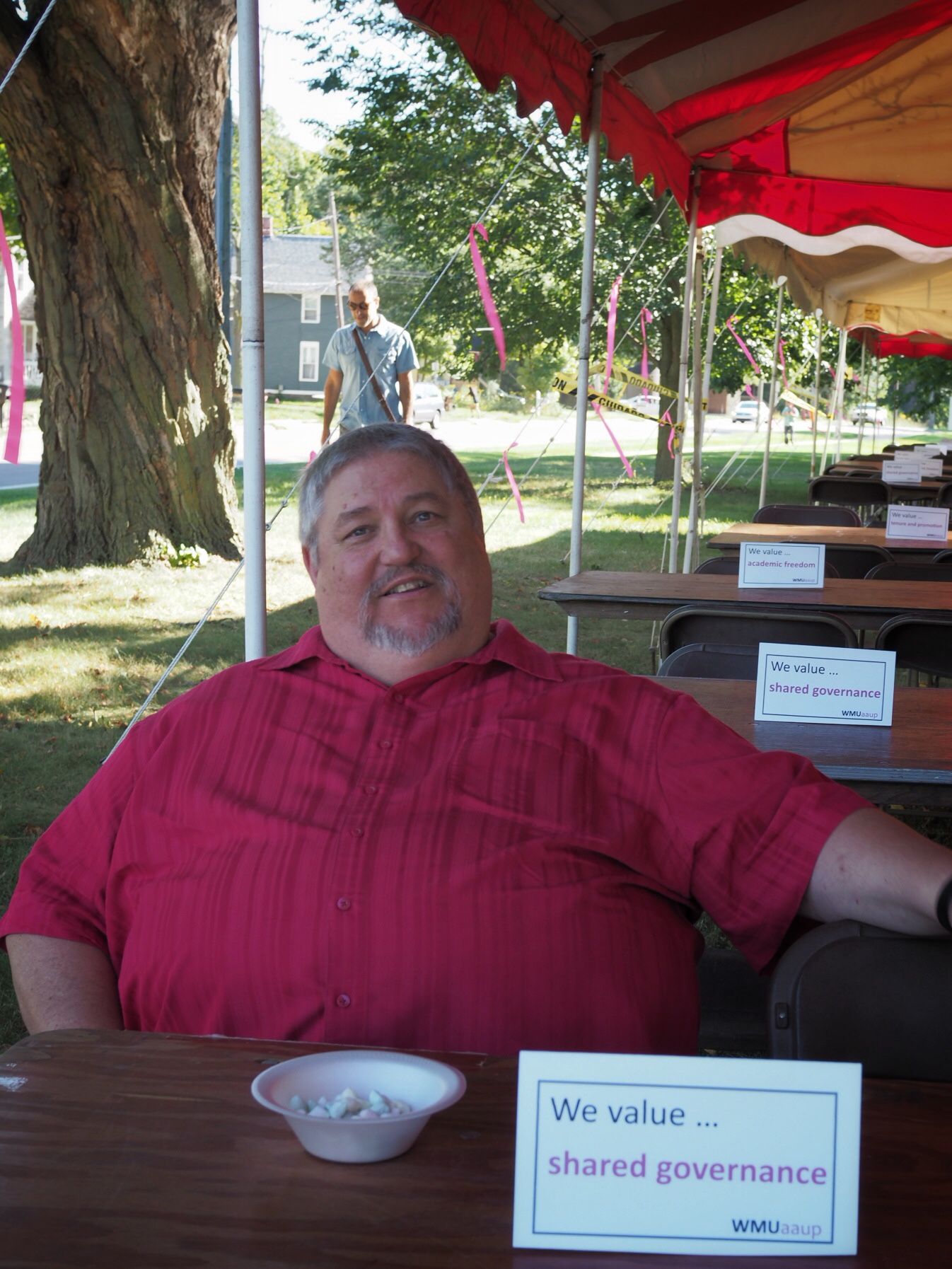
Thanks to the efforts of WMU-AAUP staff, countless behind-the-scenes workers, and perfect weather, our annual member barbecue was a huge success. As we dive into another school year, one that promises both predictable and surprising challenges, it was gratifying to spend an evening catching up with old colleagues and meeting new ones. We faculty don’t have nearly enough opportunities to connect across campus and be reminded that the strength of the WMU-AAUP is in the determination and tenacity of its members.

As you’re looking for additional ways to connect with nearby and far-flung WMU faculty colleagues, here are a couple of possibilities for this semester:

  • Drop in discussion over coffee at Montague House this coming Tues., Sept. 10 at 9:30
  • New faculty luncheon for department reps (association council members) and new AAUP colleagues on Sept. 20 in Bernhard 157 at 1:30
    Fourth Friday happy hour for AAUP members on Sept. 27, 5:00 at Arcadia Brewing

Also consider following us on Facebook and Twitter where we make near daily posts, and keep an eye out for email updates. We are stronger together!

In wake of WMU-AAUP grievance, WMU reverses course on prescription drug changes

Earlier this summer, the WMU-AAUP learned that, as of July 1, 2019 WMU had mandated that some prescription drugs accessed through Sindecuse were to be limited to 30-day quantities. The explanation was that Sindecuse Pharmacy had been losing money as a result of Blue Cross’s practice of under-reimbursing pharmacies for the ongoing, month-to-month prescriptions that many of us rely upon.

Even the incomplete list of impacted medications underscored the disturbing breadth of impact this would have: for example, asthma medications (Advair, Pulmicort, Combivent), depression (Viibryd, Latuda), blood thinners (Eliquis, Entresto, Xarelto), and several ophthalmic and GI/Bladder prescriptions.

The problem, as you may know, was that WMU’s proposed actions were in violation of Article 33.5.1 of the WMU-AAUP Agreement which states that: Prescription drugs will be available at the Sindecuse Health Center pharmacy with specified co-pay levels (e.g., $10, $20, etc.). It further states that “A ninety (90) day supply of maintainable drugs will be available for a 2.25x copay…”

In short, the Sindecuse prescription benefit is one for which the WMU-AAUP successfully negotiated – it is built into our contract – and cannot simply be unilaterally voided or reduced by WMU Administration. Consequently, we filed a grievance against WMU, after which WMU issued the statement below by email to the WMU community. We are proud of the hard work of Chapter leaders and staff on this critical healthcare issue, and grateful for the collaboration of vocal faculty colleagues. Solidarity and shared governance work!

Dear Colleagues,

Effective Tuesday, July 23, Sindecuse Pharmacy resumed providing all 90-day supplies of maintenance drugs. Those clients eligible for 90 days and supplied 30 days during the period of July 1 through July 22 will be contacted by Sindecuse and offered 60 days of additional medications at the difference of the 30- and 90-day-supply co-pays. If you are not contacted but feel that this impacted you, please reach out to Sindecuse for a further review of your account.

Sincerely,

Diane K. Anderson, Ph.D.

Vice President for Student Affairs