WMU faculty experiences and perspectives: Can we quote you?

WMU faculty have rarely been shy when it comes to expressing their preferences, insights, point of view, or simply sharing their experiences. But in the past year, faculty have been unusually forthcoming, and through many and various modalities, for example:

  • WMU-AAUP surveys, for example, about workload concerns
  • official Chapter referendums on particular issues, for example, about the administration’s academic restructuring plan and pandemic safety
  • official Chapter votes, for instance, in the election for WMU-AAUP President and Vice President
  • scores of emails to the Chapter, many with wrenching accounts of workload violations and other abuses
  • poignant testimonies, sometimes tear-filled, at WMU-AAUP meetings, especially about careers and lives damaged during the university’s pandemic response this past year

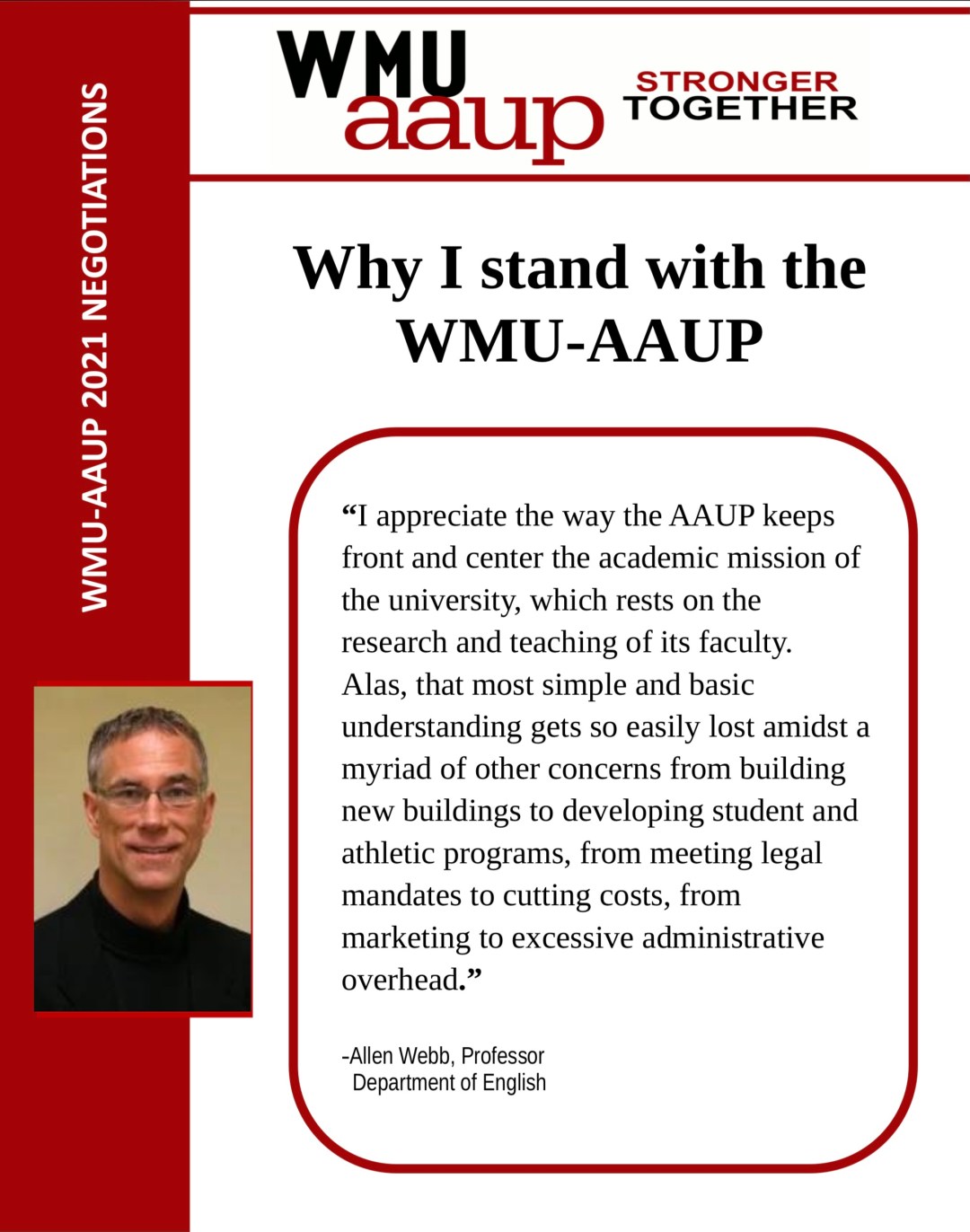
As we proceed through what is shaping up to be a challenging negotiation process, your ongoing generosity with your thoughts and experiences matters more than ever. If you feel moved to do so, then, please take a few moments to tell us about your experiences or perspective (staff@wmuaaup.net) either specifying your wish to remain anonymous or with permission to use your name. Whether you’re describing challenges you’re facing, your reasons for supporting the WMU-AAUP, or your love for our university, we want to hear from you. While we won’t be able to feature all faculty submissions in graphics like those contained in this post — to be circulated in social media and through other means — each faculty voice will help us continue to build a picture of the challenges we’re facing and the strengths that will see us through them.

When WMU faculty voices are dismissed…

The WMU-AAUP has taken many steps to ensure that its initiatives and statements are rooted in the will of its members. First, we have used numerous surveys, polls, and votes. The results have been impressive, including in the November election for Chapter President and Vice President — with very high numbers of participation — and, on a number of key issues, remarkably univocal. In addition, at all-member Chapter meetings, and meetings of the Association Council (department reps), and in countless emails and one-on-one meetings, WMU faculty have spoken out in unusual numbers and with extraordinary candor.

To be sure, no organization can satisfy the wishes of all its members and there’s no use pretending otherwise. But it’s also good to keep in mind that a classic divide-and-conquer strategy used against those engaged in collective action is to question the basic legitimacy of the group expressing concerns. Far too often, here’s what happens: Instead of listening to repeated worries, suggestions, and complaints expressed by campus community members, including faculty, administrators insist that such expressions are those of a “radical fringe” and don’t represent a supposed “silent majority.” No matter how many voices speak up, nor how loudly or reasonably — including through damningly direct performance evaluations — administrators may continue to justify actions and policies by effectively dismissing whole swathes of the campus community as disgruntled, whiny, or difficult. Such administrators may be listening to some faculty voices, of course, especially those that consistently, and sometimes publicly, celebrate and applaud them.

It is frustrating and dangerous when such dismissive and trivializing strategies are used against any group, but it is especially pernicious when it happens during negotiations, and when the group in question is a legally recognized collective bargaining unit, the official voice of its members. As we have all seen in recent years, tirelessly spreading rumors that cast doubt on the legitimacy of elections, polls, and properly collected qualitative data is a tactic employed by those desperate to believe they are right. No matter what. It is precisely because of such stubbornness and wishful thinking that the WMU-AAUP, including the individual voices of its members, must continue to speak up. This is especially important now, as we are in the midst of negotiations, fighting not just for faculty salaries and decent benefits, but for the ongoing viability and dignity of the professoriate.

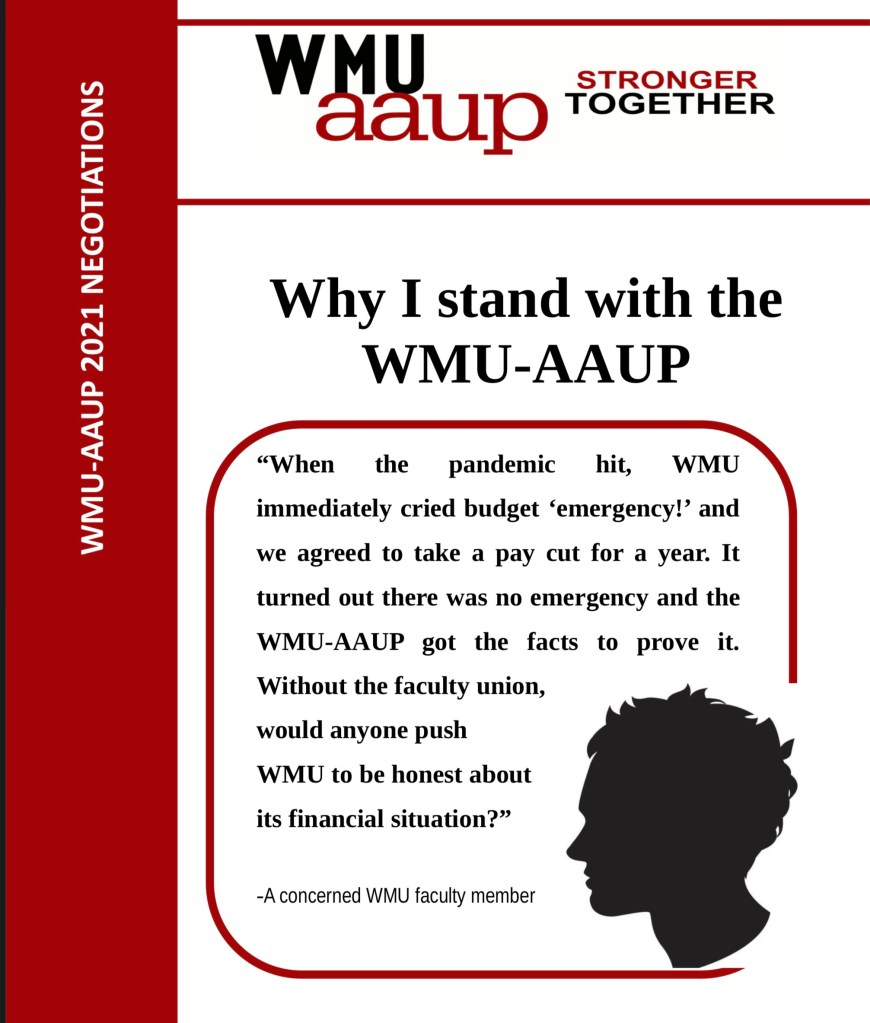
During negotiations, the WMU-AAUP will be finding new ways to share members’ experiences and messages of concern, then, for example, in graphics like the one below. Please contact us at staff@wmuaaup.net if you have experiences you’d like the Chapter to consider highlighting in these campaigns.

Taking stock of WMU academic labor relations

a message from the WMU-AAUP President and Vice President

Dear Colleagues,
Almost nine months ago, we reached out to you as candidates for WMU-AAUP President and Vice President. With faculty labor being exploited, and faculty input being all but ignored, we asked you to stand with us to advance goals and values aimed at restoring shared governance. After being elected by overwhelming numbers in November, taking office in January, and completing our first semester as your Chapter leaders, we are now in a position to both take stock and also share some new concerns with you.

To begin with, we are confident that having new Chapter leadership in place is bringing about positive change with respect to WMU-AAUP and campus dynamics. The Chapter has stepped up efforts to take direction from members; adopted a collaborative, but skeptical, approach to administrators; increased its emphasis on building partnerships across campus; and embraced the fundamental AAUP values on which our organization was founded. Our focus is on academic freedom, shared governance, equity, and the protection of contractual due process.

In recent months, then, your WMU-AAUP has been more engaged, more assertive, and more vocal. Unsurprisingly, the Chapter has also been facing a backlash. Against the backdrop of pandemic fear and confusion, WMU seems now to imagine a compliant faculty happy to make endless sacrifices. As many of you have reported, there seems to be a greater expectation that professors should simply obey, sometimes with little regard for the Contract, Departmental Policy Statements, or even considerations of basic fairness.

Unfortunately, as the WMU-AAUP has become more proactive in defending members’ rights, we are experiencing instances of administrative stonewalling, delay, and apparent attempts to marginalize and intimidate us. To take an especially bold example, last month, WMU invented a new hybrid faculty-administrator position titled “Interim Associate Director of Academic Labor Relations.” WMU then appointed the previous WMU-AAUP Grievance Officer to the post just weeks after he had resigned his position with the Chapter. WMU has effectively moved him from one side of the table to the other while nominally preserving his faculty status.

The impact of unprecedented administrative stunts of this sort is, predictably, chilling for faculty members involved in, or contemplating pursuing, contractual processes or concerns. The situation is exacerbated by the fact that WMU is engaged in such maneuvers while repeatedly and summarily dismissing substantive and credible faculty concerns, complaints, and grievances. Again, there seems to be a worsening pattern in which WMU Academic Labor Relations is reluctant to collaborate consistently with the WMU-AAUP in good faith.

To be sure, we will continue to use all the tools at our disposal to address overreach and abuse while remaining open to opportunities for collaboration with our administrative colleagues. But the most powerful recourse we have is, of course, rooted in the faculty’s determination, knowledge, and unity. We share this message with you, then, as a sign of new possibility. After all, if the WMU administration is busy devising new strategies to distract the faculty or dismiss our voices, this is a sure sign that they know we are a force to be reckoned with.

In solidarity,
Cathryn Bailey, President of the WMU-AAUP
Natalio Ohanna, Vice President of the WMU-AAUP

This message was originally shared with WMU-AAUP faculty by email on May 18, 2021.

2021 Negotiations begin!

WMU-AAUP contract negotiations officially began Thursday, May 13. As you may know, our exceptionally hardworking negotiation team members — Whitney Decamp (Chief), Charles Crawford, Regina Garza Mitchell, and Robert White — bring considerable experience and expertise to the process. They are well prepared, and eager to bring faculty priorities to the bargaining table.

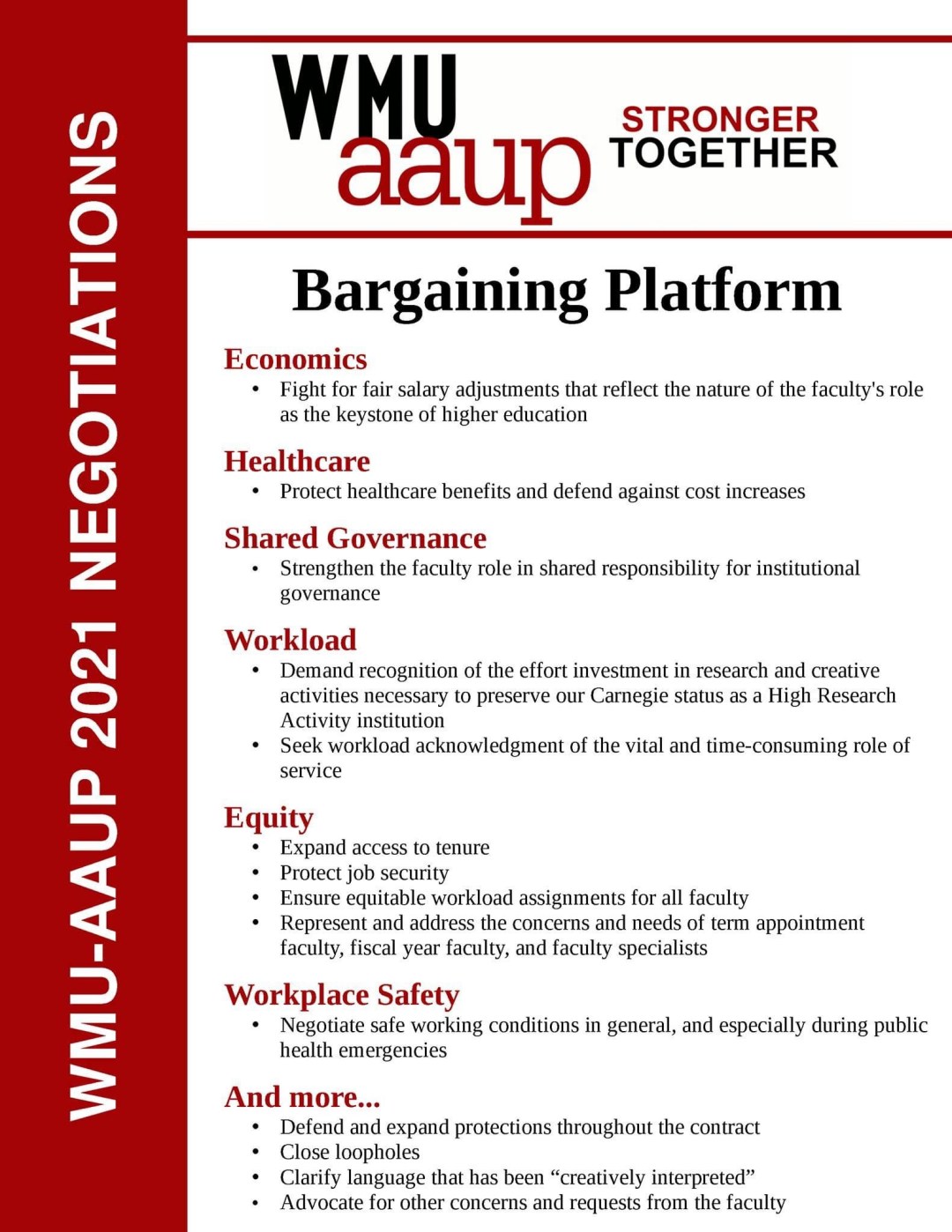
The Chapter will provide ongoing negotiation updates. We will also be in touch about how members and allies can support this process to help ensure that we have a successful outcome. This is a critical moment to recall that our strength is in our unity and that the terms of the WMU-AAUP Contract have implications for nearly every other WMU employee group. Whether you are a member or an ally, please share the bargaining platform widely to demonstrate your support for our team, our union, and our university.

How successful are we at WMU at expressing our research-intensive values?

How many undergraduate students know the difference between a research-intensive university and one that is overwhelmingly teaching-focused? Even if students can recite some of the differences, how many of them even care? Further, to what extent are faculty members in touch with the reality of how well our university actually measures up to the values and mission associated with being research-intensive?

At universities like WMU that identify and market themselves as both research-intensive and focused on undergraduate education, these may be especially important issues to grapple with. After all, if we, ourselves, are not clear about how well our institution fulfills its claims to be research-intensive, we can’t help students appreciate this quality. As we reflect, then, here are a few reminders of some criteria generally associated with being research-intensive.

Such universities:

  • invest in faculty scholars and researchers, providing workloads, facilities and other resources (e.g., library, equipment, grant preparation, and travel funding) that facilitate and nourish such activity
  • place a high value on attracting and supporting promising graduate students across a broad range of disciplines; while such students may directly contribute to the teaching mission, their identities as scholars is primary
  • facilitate and encourage individual faculty efforts to incorporate their research into their teaching by, for example, providing grants and release time
  • foster and maintain specialized undergraduate majors and internships, instead of supporting only the most popular, fashionable ones
  • eliminate institutional roadblocks that impede interdisciplinary collaboration, for example, team-teaching or joint research projects

When considering our university, how would you respond to these questions? What other criteria are critical for assessing a university’s designation as research-intensive in ways that might matter most to faculty and students? And what other questions should we be considering when we ponder the future identity of our university as research or teaching-focused?

WMU without the WMU-AAUP? What a difference academic collective bargaining makes!

After more than four decades of living and working in the reassuring presence of a well-crafted, comprehensive, mature contract, it’s easy to become complacent about the guarantees and protections that have come to shape WMU’s campus life. And, to be clear, though the WMU-AAUP Agreement has been forged specifically between WMU and the WMU Board-appointed faculty, this foundational document impacts our entire campus culture. In short, the power of WMU’s professoriate to bargain for fair wages, decent benefits, and shared governance has led to the creation of a campus community that is far more transparent, democratic, and humane than it might otherwise be.

Because it is far too easy to forget what it used be like, consider the routine risks of living and working on a campus with no formal collective bargaining power:

  • compensation and benefit structures that may be decided on arbitrary, or so-called “market based” criteria, with little hope of predictable raises, or of avoiding drastic healthcare insurance increases;
  • tenure and promotion procedures that are opaque and draconian and that may include no formal avenues for appeal or challenge;
  • the power to summarily eliminate departments and faculty positions according to economic vicissitudes and administrative whims;
  • unchecked disciplinary procedures according to which administrators might determine a faculty member’s guilt and assign penalties with no provisions for due process;
  • a climate in which all mid and higher level decisions may be made by admin, including those with direct implications for academics, with little or no input from faculty

In short, before there was the WMU-AAUP, life here was a lot like it is at other non-unionized campuses at which faculty members function as laborers serving at the pleasure of management. Even an occasional, cursory glance at national higher education news makes clear that faculty colleagues at many other campuses live in a shadow of fear and uncertainty that impacts their wages, capacity to exercise academic freedom, and, yes, their mental health. The fact that many of us at WMU may no longer feel moved to actively celebrate the rights and advantages we have earned through our collective power is perhaps the greatest testament to the WMU-AAUP’s astonishing success over the decades.

And, again, though not all campus employee groups share equally in these advantages, the positive impact of the WMU-AAUP on the entire campus is evident, including:

  • a tendency for enhanced wage and benefits for many non-faculty employees, given how the WMU-AAUP’s negotiated wage and benefits packages influence subsequent agreements made with other employee groups;
  • a campus at which other employees are more likely to feel supported as they embrace their right to organize, for example, AFSCME, PSOA, POA, MSEA, IATSE, TAU, and the PIO, all further ensuring a healthy check and balance on unrestricted administrative power at WMU;
  • a climate of shared governance according to which there is precedent for employee demands of participation and transparency, an environment in which employees’ right to ask questions and expect answers becomes more normalized and likely

Though it may be true that the WMU-AAUP’s consistent success and effectiveness tempt us to take it for granted, as we prepare now for 2020 negotiations, it’s the perfect time to imagine life at WMU without our faculty union. In fact, we don’t have to tax our imaginations at all if we simply invite the perspective of longtime WMU faculty members, including one retired early WMU-AAUP leader who is eager to share cautionary anecdotes with all who will listen. “We were completely at their mercy,” he recalls, “and the only real leverage we had when we knew we were being treated unfairly was to quit our jobs, pack up our families, and leave.”

Can WMU do more to address the student mental health crisis?

At a Board of Trustees meeting, the WMU-AAUP urges greater attention to student mental health and the faculty professionals who provide mental health services

Delivered by WMU-AAUP President, Prof. Carol Weideman
December 13, 2019

Thank you for this time to speak. The WMU-AAUP is a faculty voice that isn’t always easy to hear. I understand that it may seem like we consistently identify problems, but it is our job to protect the contractual agreement that was signed between the BOT, administration, and our board appointed faculty. By doing this, it creates a safe place where we can challenge each other, and ultimately have a stronger institution.

First and foremost, I’m proud to be a faculty member of WMU, ranked #1 in the top 10 best Hidden Gems of public universities in the US. We will be celebrating the next group of graduates this upcoming Saturday, and I’m looking forward to seeing the fabulous smiles, the jubilation, selfies, and as always, the shoes.

In the short time I have for my remarks, I’d like to raise an important concern. In a meaningful discussion with President Montgomery last week, the WMU-AAUP VP, Mark St. Martin and I raised our concerns about the current status of student counseling needs and transparency between the administration and the university community as a whole. I can speak more about the transparency conversation at a later date; for now, I’ll focus on the mental health/counseling needs.

This was not an unfamiliar topic with President Montgomery, and so we were able to freely express the basis of why we brought the topic of counseling needs and faculty security to our meeting. President Montgomery understands the mental health concerns we are facing, and Mark and I felt the discussion was lively and heartfelt. Just a few days before our meeting, the Kalamazoo Gazette featured an article entitled “Student need for counseling surges.”, with the subtitle “More college kids are turning to schools for help with their mental health, and schools are struggling to meet demand.” (December 1, 2019.) This article outlined the disparity between need and available resources across many university campuses. WMU is not alone with trying to find ways to counter the number of students needing mental health treatment, and we understand the administration is working on this challenge.

This is some specific data I will share regarding the mental health status of college students from a national data set. There is a distinct trend in the increase in percentages of students experiencing overwhelming anxiety (30.7% last 2 weeks, 14.1% 30 days) and felt so depressed that it was difficult to function (17.5% last 2 weeks, 8.9% last 30 days). There also is an increase in students coming to campus with diagnosed mental health issues. In this same report, 24% of students indicate diagnosis or treatment by a professional due to anxiety and 20% with depression, and 12.3% reporting panic attacks within the past 12 months. Approximately 53% of students reported that their academic responsibilities are very difficult to handle. These are just a snapshot from the undergraduate data from the Spring 2019 American College of Health Association National College Health Assessment. Our university last participated in this assessment in 2015, and the data is an important resource for our programmatic planning.

With the development of Think Big, there was a clear ‘new purpose for higher education in society’, and that is wellness. The presenters at the fall Town Halls provided many infographs, and one that stood out to me was the placement of mental health as the foundation. As stated on the wmich.edu/thinkbig website, “Wellness combines with a strong mind and becomes central to our purpose.”

As we enter 2020, we need to consider how we will move forward with providing sufficient mental health care for our students as well as providing the excellent staff we currently have with positions that have stability.

First question: Do we have enough counselors? The International Association of Counseling Services recommends one therapist for every 1,000 – 1,500 students (https://iacsinc.org/staff-to-student-ratios/). The Fall 2019 Census data indicates 21,470 students, from the Sindecuse directory, it appears we have 10 counselors and one intake staff. Only one of those 10 holds a Ph.D and is the only licensed psychologist in the center. Our counselor/student ratio is dismal compared to the accepted recommendations. As a reference point, GVSU has 10 PhD level licensed psychologists (in addition to their master level counselors).

Second question: What is our mental health resource plan for Think Big and are mental health professionals on the planning team? If so, who? The resource plan that is available online is the WMU Healthy Campus 2020 Student Mental Health Action Plan. Two objectives are identified: the first to increase utilization of mental health resources and the second to increase resiliency. This plan appears to be developed on the proportion of students who have same day appointments vs improving the quality of mental health resources. We must first act to ensure we have the professionals to take care of these students. Second, we must ensure we take care of those who take care of our students.

Having a solid team of tenure track counselors, who don’t have to constantly worry whether they have a job next year or not, that can provide students consistent mental health treatment throughout the academic career is what can and should set us apart. Students are coming to campus with more mental health concerns, and treatment consistency is what they seek. Having counseling appointments with the same professional allows a connection to be formed which research shows is the biggest factor in therapeutic change, diminishes the need to reexplain their history and presenting concerns, and provides the opportunity for intensive work.

Currently, we have a crisis where the majority of counselors are on term appointments, which is defined as “appointments are for one-year periods and are renewable annually for up to five (5) consecutive years.” With mental health support the foundation of the Think Big initiative, we raise the need for stability for the Counseling Services faculty. It’s well understood that employees who are risk of losing their jobs show higher perceived stress, anxiety, depression, and negative feelings and lower levels of positive feelings compared to employees not at risk of losing their jobs. People with job insecurity also feel less belonging and lower ties with the working population. This is what many of our counselors face on a yearly basis.

The challenge the WMU-AAUP is facing is how to encourage the administration to recognize the precarious position these individuals are in. We stand in the faith that the BoT and WMU administration believe in shared governance and academic freedom. Providing the pathway to tenure which is ensured in the 2017-2020 agreement will provide these individuals to fully participate, contribute, and better our university. The union urges the administration to work with the faculty to tackle the reality that it’s time to give our counselors the support they need to fully support our students. Mark stated it well when he said “We have to take care of the people who are taking care of our students.”

Again, I appreciate the opportunity to share this message from the bargaining unit.

(Image above from https://www.apa.org/helpcenter/emotional-crisis)

Why the WMU-AAUP continues to thrive in the face of incredible challenges

Despite ongoing legislative attempts to throttle collective bargaining efforts by making it harder for unions to maintain robust membership, WMU faculty overwhelmingly continue to support the WMU-AAUP. In fact, though some form of so-called “right to work” laws have been in place in Michigan since 2013, 90% of eligible WMU faculty continue to support the union as full dues-paying members.

As some collective bargaining units across the nation have struggled to maintain membership in the face of increasing anti-union challenges, our union membership numbers are especially impressive. Out of a total of about 900 eligible faculty, only 45 tenure-track and 11 term faculty have committed to opting out. While we continue to reach out to to a handful of additional WMU faculty who have not yet submitted cards, the overall numbers are remarkably positive. Again, 90% of WMU faculty continue to fully support the Chapter as dues payers despite explicit attempts to dilute our solidarity.

No doubt this success is due, in part, to the WMU-AAUP’s implementation of a comprehensive member outreach plan in recent years designed to respond to the latest anti-union threats. This plan has included direct, intensive outreach to new faculty, including over the summer, and ongoing targeted communications throughout the year in the form of letters, phone calls, office visits, and emails. In addition to this painstaking work by WMU-AAUP staff and officers, AAUP department representatives (Association Council members) are on the front lines with respect to engaging with colleagues who have questions about membership, or somehow simply forgot to submit their dues card.

Our member outreach plan, combined with plain old elbow grease, is surely part of the secret to the Chapter’s impressive success, but the deeper explanation is likely much simpler: the WMU-AAUP’s impressive record of fighting for fair salaries and decent benefits, of doggedly standing up for faculty rights, and of offering critical guidance through a maze of bewildering processes, especially the rocky shoals of tenure and promotion.

In short, WMU faculty have a deeply rooted ethos of supporting our collective bargaining unit because of the value it brings to our individual and collective professional lives. As higher education withstands wave after wave of insult and assault, including threats to the basic viability of the professoriate, we invite you take a moment to celebrate the fact that WMU faculty are standing strong. We are, in fact, more united than ever in our commitment to fight for what is right and fair as we head into another negotiating season.

The invisible labor of WMU professors: Three lessons from your own workload stories

Probably the most striking conclusion of the workload comments faculty have shared with the WMU-AAUP this semester is that, when it comes to research, teaching, and service, we professors are in the best position to tell our own stories. In fact, in sharing the interesting, sometimes idiosyncratic, details of their work responsibilities, faculty have described feeling isolated and misunderstood, not just by administrators, but sometimes even by faculty colleagues.

For example, one faculty member observed that “there seems to be an assumption that because I have a heavy teaching load that I must not care about scholarship, but I never stopped writing and publishing articles even though I’m given almost no time to do it.” Conversely, another professor shared that he is almost afraid to talk about how low his official teaching load is with colleagues outside his department because “it gives people the wrong idea. The fact that my official teaching credits are low doesn’t do justice to how much time I’m actually required to spend working with individual graduate students.”

Other faculty described frustrations about how research, scholarship and creative activity are recognized and valued. As one professor explained, “Scholarship in my field takes time and my department understands this. But for people in departments that emphasize lots of co-authored articles rather than books, it must look like I’m just sitting on my ass.” Another faculty member emphasized the painstaking process of securing and managing external grants, and of how this “basically becomes an entire job unto itself, in addition to the actual research the grant is supposed to fund.”

Not surprisingly, service was another area about which faculty expressed frustration, suggesting that too much of this work was rendered invisible by “bean counting administrators.” One professor described the increased pressure he’s felt over the years as his department’s faculty numbers have dwindled. “At the same time, the service demands have gone up,” he said. “There seems to be no recognition that fewer faculty members are being asked to do more and more.” Another faculty member explained that much of what claims her time seems to fall outside the recognized workload parameters, for example, “Every single week a handful of students stop in for informal advising discussions. I want to help them, but they aren’t even ‘my’ students. Am I supposed to turn them away?”

Though no single, overarching theme emerged from the workload stories shared with the WMU-AAUP, three were repeated enough to serve as cautionary lessons.

  • First, there is the recognition that the work faculty do across colleges varies, sometimes dramatically, and that no numerical system can fully do justice to this diversity.
  • Second, the best experts for determining what counts as meaningful research, teaching and service work in a given field are to be found in that field; WMU faculty are the best experts with respect to workload evaluations.
  • Third, more discussion is needed among faculty across departments and colleges to better understand and appreciate the diverse value we bring to WMU. Now, if only we could find the time!

Below are additional examples of labor that faculty feel may be misunderstood or rendered invisible. What did we miss?

– writing, customizing, and uploading student reference letters for graduate schools, professional programs, and academic employment

– engaging in industry consulting work that may be both expected and appropriate to one’s academic role

– informal academic and personal advising of undergraduate students, especially those who arrive underprepared

– driving time to teach courses at WMU distance learning sites, especially in the winter

– serving on diversity and inclusion initiatives, especially for faculty of color

– remaining current in one’s academic discipline, especially when one’s field is international in scope

– dealing with the ongoing demands of accreditation reports and other documentation

– completing a myriad of WMU online trainings, for example, cyber security and bullying

– direct individual supervision of students, especially graduate students, in required internship or performance activities

– completing time-consuming academic program review documentation as periodically required by administration, especially when this work has no apparent consequences

– piecing together small funding opportunities for routine academic work in the absence of sufficient support for conference and research travel (especially when international)

– completing professional activity reports, especially when one’s accomplishments do not fit neatly into its categories

– work done for the Lee Honors College, for example, scholarships, thesis committees, and serving as speakers

– participating in curricular overhauls, for example, essential studies

– facilitating the needs of increasing numbers of students who require special accommodations, for example, extra exam time

– assisting with departmental, college, and university recruitment efforts, e.g., spending time with prospective students and their families

– multiple (rather than streamlined) progress (and midterm grade) reporting for undergraduate students, for example, those on probation

If you haven’t yet had a chance to share your workload story with us, please send it!

Note: Faculty find much of this work to be both important and satisfying, but wish that it were better factored in during formal and informal assessments of their overall contributions. Also, some details have been altered to preserve anonymity.

How is investment in core academics part of WMU’s plan to address enrollment declines?

WMU’s enrollment has been in decline for years, due partly to predictable demographic shifts, and WMU is responding with a marketing initiative to make the university more attractive to a shrinking group of traditionally-aged prospective students. It’s no surprise that, amid the generation of new slogans, enhanced residence halls, and other student enticements, faculty are asking questions about the university’s investment in its core academic mission. For example:

  • How is the ongoing shift away from full-time tenure track faculty toward poorly paid part-time instructors consistent with WMU’s promise to provide a world-class education?
  • Is WMU’s investment in its “research-intensive” status sufficient to help prospective students distinguish WMU from community colleges and other, more affordable, four-year institutions?
  • Will core university basics, including traditional disciplines and general education, be sacrificed in order to feed trendier majors?
  • Will significant, ongoing investments be made in academic advisors, librarians, counselors, and academic student success programs to help students progress in WMU’s relatively open enrollment environment?

There are, of course, more general questions underlying worries about universities’ value commitments in the midst of increasingly assertive efforts to identify and draw in more students. For example:

  • How committed is the university to investing in quality over time, enhancing the institution’s long term reputation for excellence, rather than quick fixes?
  • Given that its employees — faculty and staff — distinguish a university as special, what investment will be made in actual people, above and beyond funds spent on facilities and marketing materials?
  • How does the institutions see its responsibility to respond to campus climate issues, for example, concerns about racial and gender equity, as consistent with its efforts to attract more students?

Though “austerity” is not a word most universities use to describe their response to enrollment declines, and the more or less predictable budget contractions that accompany them, many faculty and staff feel the threat of austerity in the air. With that in mind, it is reassuring when a university makes proactive, concerted efforts to become more appealing to students. But, for many faculty members, after years of watching our academic departments shrink and wither through attrition and disinvestment, it is understandable if we have serious concerns about investment in core academics.

Will faculty lines continue to melt away as state-of-the-art buildings are erected and new billboards and tv commercials appear? Will faculty and staff be left to foot the bill for glitzy marketing strategies that may feel good in the moment but have little long-term impact? Whether we will choose to see this latest chapter of enrollment decline as an opportunity to substantively invest in the people — students, faculty and staff — at the heart of our core academic mission remains to be seen.