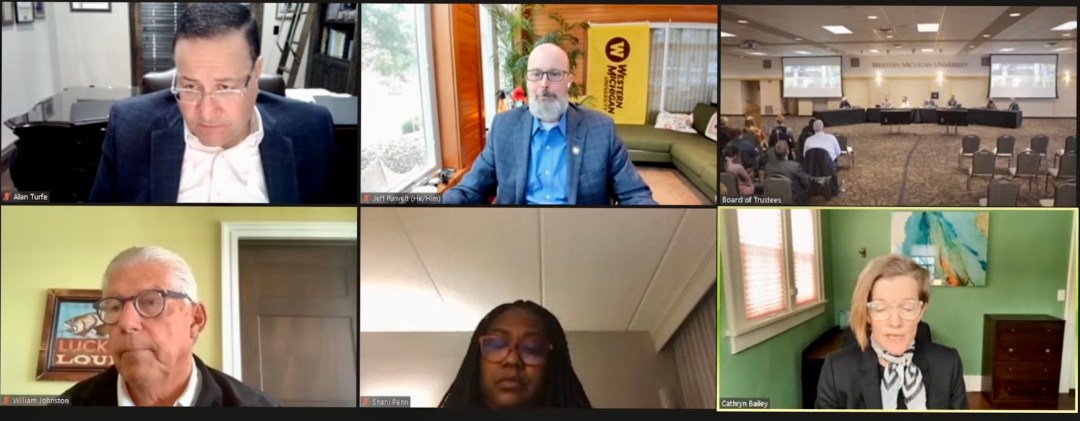
WMU-AAUP negotiations 2024: opening statement

Remarks delivered by the WMU-AAUP team at the June 13 opening of salary and healthcare benefits negotiations with Western Michigan University

Good morning. The reopener to the 2021-26 Agreement for economic compensation and health care benefits and insurance arrives at a critical time for the membership of the WMU-AAUP. As the negotiation team has researched and prepared for collective bargaining, we have met with faculty over numerous listening sessions and surveyed the membership directly. The direction we received from the faculty is clear: there is a need to ameliorate the rising costs of living, to acknowledge the contributions and sacrifices faculty have made, and a demand for comprehensive, affordable health care for members and their families. The time is now to make an investment in faculty to ensure we have access to a comfortable standard of living and a secure future, an affirmation of the indispensable role of faculty, as scholars and educators, in making WMU a distinctive institution. 

The negotiation team looks forward to engaging in productive discussions with the administration to address these challenges that impact the day-to-day experiences of our membership. We believe a mutually beneficial agreement on compensation and health care is possible. After all, the well-being of our membership enhances the institutional and educational goals of WMU. In this opening statement we would like to spend a few minutes outlining the concerns and priorities of our membership, but first I would like to pause and introduce the members of the WMU-AAUP’s negotiation team: Dr. Regina Garza Mitchell, Dr. Jean Kimmel, and myself, Dr. Andrew Hennlich, chief negotiator. We are also joined by Erin Dornbos, WMU-AAUP attorney and Lori Maguire WMU-AAUP Operations Manager. 

Economics 

Simply stated, our membership needs real raises. Ones that respond to the years of declining value as the cost of living has increased. As the recent AAUP Faculty Compensation Survey shows, faculty at WMU have experienced a significant decline in earnings when adjusting for the Consumer Price Index for Urban Consumers (CPI-U), the US Department of Labor’s statistic for measuring changes in the cost of living. From 2015 to December of 2023, the WMU faculty have experienced significant declines in their earnings across all ranks, including: 

● 17.6% for full professors

● 15% for associate professors

● 15.5% for assistant professors 

● 8.8% for instructors

As we met with our members we have heard stories of the very real impact of those statistics.  During a chapter-wide listening session, one faculty member described the material realities many of us face: 

“Prices are going up in Kalamazoo, housing prices, etc. Property taxes. We have no control over these things, but we also have no savings or reliable increase in salary in order to maintain a basic living standard. . . . I am on worse than a fixed income. . . I am not only falling behind, I am falling into debt. . . . I want a quality of life and a salary where I can keep up with the changes that come at us from property taxes, water, tuition for kids in college, etc. . . .To be compensated in a way that is fair and equitable.”

This faculty member is not alone in feeling these pressures and the urgency of fair and equitable compensation. When surveying faculty we also heard another describe the heartbreaking decision of having to choose between healthcare coverage and groceries. We need to work together to find solutions to these challenges for faculty to feel security in their material conditions of living, and as members of the WMU community.

Keeping pace with inflation is not enough. The WMU-AAUP will call for additional adjustments to salary in acknowledgment of the diverse, unique talents of the board-appointed faculty.  Salary increases must also acknowledge the faculty’s creative energies, research acumen, and the passion and insight we bring to the classroom; contributions that are, fundamentally, what makes Western, Western. Despite declines in the overall number of faculty, President Montgomery lauded the externally funded research expenditures [that] saw a 24% increase over the previous fiscal year, totaling $35.3 million, which is a high in at least the past 21 years. Total awards, meanwhile, reached $41.9 million, an 18% increase over the previous fiscal year’ during his 2023-4 State of the University address.

These accomplishments directly contribute to the financial health of the institution, as President Montgomery notes, but it is important to acknowledge how the faculty enhance WMU in a multitude of ways beyond economic value: books and journal articles, performances, concerts and exhibitions, consultancy and public service, teaching and mentorship are a few of the myriad ways faculty contribute to Western. We deserve to be acknowledged for this work, and for the sacrifices we have made since COVID including confronting physical and mental health challenges for students and faculty alike, shifting to multiple instructional modes, student preparation, and significant decreases in administrative support for faculty work.

Salary adjustments must address both the cost of living and our performance as employees. Accordingly, we need to increase salary minima to address the acute impact the cost of living has on faculty who are on the lower end of salary at rank, and to enhance promotion increments in acknowledgement of the excellence these accomplishments represent. A robust, fair, and just compensation package for the WMU-AAUP is an investment in the institution’s well-being and its future, ensuring excellence in scholarship and in the classroom.

Administrative Finances

One of our tasks as a negotiation team has been to review the financial picture of WMU.  It remains clear, from comments made by senior administrators at WMU, through a budget analysis by Dr. Howard Bunsis on behalf of the WMU-AAUP,  and our analyses of WMU’s financial records that the fiscal outlook for Western is positive. Simply stated, the administration has the means to invest in faculty. Let’s take a closer look at the numbers: 

Overall, the institution continues to report positive excess cash flows in each year since 2014, WMU takes in more money than they spend. In other words, it turns a profit. Revenues have increased nearly $46 million since the COVID low point in 2021. Reserves have grown in excess of $381 million. And state appropriations are healthy (at a recommended 2.5% increase for 2024-25, which follows a 4.9% increase received for 2023-24 ). The WMU 2023 Audit Statement declared that the University was in a strong financial position, a sentiment echoed by President Montgomery in his State of the University Address. He noted that we are in the third year without a budget cut, and $3.5 million was returned to the colleges for their discretionary use. In addition, Empowering Futures is helping WMU grow by providing services and scholarships for students, which should make it easier to pay faculty what they are worth, something our President stated as a goal: “it’s estimated that by 2027-28, that midpoint, WMU would have an additional $32 million more in revenue. These additional resources will allow us to invest in our faculty and staff and to further our mission as a student-centered public research University.”

Despite enrollment challenges felt across the nation, WMU continues to grow. New student enrollment was up this year by 2%, including a 7.2% increase in graduate students and 1.1% increase in new undergraduate students. It is also worth noting that our first-to-second-year retention rate was 79.8%, and graduation rates have also increased. Faculty played a tremendous role in those changes. And yet, we note that Western has failed to make that investment in faculty. From 2016 to 2022 the salary for ‘Institutional Support’—IPEDS’ term for ‘for general administrative services, central executive-level activities concerned with management and long range planning, legal and fiscal operations, space management, employee personnel and records, logistical services such as purchasing and printing, and public relations and development’—increased by $1.1 million, while salary for instruction declined about $8.6 million. Though institutional support has declined marginally from 2019-23, it is nothing compared to the decline in spending for instruction. These data raise an important question: What are the administration’s priorities? Is it instruction and research or an ever-growing administrative class? Again, we emphasize that Western has the means to support faculty, the question is its willingness to do so. 

Health Care 

During our meetings faculty have naturally brought up concerns about their health care and insurance benefits. They remain anxious about rising costs of their health care contributions. The faculty and administration are motivated by the same concerns: a need to keep costs low, whilst ensuring quality coverage. Afterall, we are on the same health plan. In that spirit, we would like to remind the administration that it is necessary we have access to relevant health care data, and would like to ask the administration’s team when such information will be available for the WMU-AAUP negotiation team and its health care analyst. In addition to concerns about cost, we have also heard faculty describe challenges within the plan structure, and we intend to work on addressing them during collective bargaining. In every listening session we’ve held, faculty have brought up the need for changes in vision care: annual checkups and adjustments to vision plan coverage of eyewear that reflects the reality of current costs and standards for optical care. Faculty have also expressed frustration over the challenges of the current prescription drug plan, particularly for members who have tier four and five drugs. Likewise, there are concerns about dental costs and network coverage, and so we will ask for a request for bids for dental network providers, so that we can make an informed, collaborative decision about the best possible coverage. As we begin to examine costs, use and spending data for the HMO and PPO plans, the team anticipates further discussions about plan structure and costs. 

Conclusion 

Again, the team looks forward to constructive dialogue with the administration to address the challenges the faculty face in their day-to-day lives, as we hope you remember the fundamental importance of our membership’s contributions to WMU as a quality educational institution. Now is the time to invest in faculty to ensure that future. Today, during our first bargaining session, the team has a few goals in mind. One, we would like to agree to ground rules for future bargaining sessions. The team has reviewed the rules from the 2021 negotiations and found those rules amenable; we have circulated those for review. Secondly, we would like to set up an agenda for future negotiation sessions.

The team has a preference for beginning with Article 33, Health Care and Benefits. And finally, we want to set up a schedule for future negotiation sessions. Our side proposes two sessions per week, to meet on Tuesday mornings from 9-12 and on Thursday afternoons from 2-5. We would also like to discuss a long-range calendar for negotiations, as there are periods where our team members will be unavailable to meet. We look forward to working with you in the coming months to find solutions to these significant challenges to the faculty, and to reaffirm WMU’s stated intention to invest in its faculty as the core of the institution’s mission. Thank you.
The WMU Administration’s reluctance to support its research mission: How Western faculty can respond

a message from WMU-AAUP President, Dr. Cathryn Bailey, and WMU-AAUP Vice President, Dr. Whitney DeCamp

We’re reaching out with time-sensitive information regarding the WMU-AAUP’s efforts to enforce the contract regarding funding for research travel. If you simply wish to learn more about what you can do to help restore travel funding, skip to the last section of this email. Otherwise, please review this full message to ensure that you’re fully up-to-date.

The backstory

As you may recall, in September of last year, we warned of draconian cuts by the WMU Administration that would result in absurdly low funding amounts, a shocking $133 per faculty member for the entire year. Although the Administration quickly rolled back part of this plan after a strong faculty reaction, it has continued to dispute faculty members’ contractual right to receive funding for two trips.

The Chapter’s position has always been that the contractual language regarding this matter is clear and unambiguous. Indeed, the most relevant sentence (in Article 34) states: “Faculty may receive travel support for up to two (2) professionally recognized meetings per year through the FRTF.” Nonetheless, the Administration denied the Chapter’s grievance filed in September regarding this matter, based, in part, on its (implausible) reasoning that “up to two” might be interpreted as just one (or even zero). When the Administration was unwilling to agree to follow the plain language of the contract, the Chapter submitted a demand for arbitration. This process includes review by a qualified third-party and would impose a legally binding solution on both parties.

While nearly everything about this process has been disappointing from our point of view—not the least the Administration’s dogged attempt to nickel and dime faculty who wish to fulfill their professional research obligations—we were further disillusioned by the university’s latest attempt to drag its feet. So, although the arbitration hearing was originally scheduled to take place this week, the Administration requested earlier this month that it be postponed. Although the Chapter objected to the delay, the delay was ultimately granted (and was accompanied by a steep rescheduling fee for the Administration). The summary, then, is that the Administration is continuing to drag its feet, creating ongoing hardship for faculty who need to plan and carry out professional travel.

What you can do

Reach Out to Faculty Senate Representatives: Even as the Chapter is following common-sense legal advice and eager to resolve this matter through arbitration, there is a memorandum of action (MOA-24/02) regarding this issue that is being proposed to be presented for a vote by the Faculty Senate at its meeting this Thursday. This MOA (among other concerns) contradicts our negotiated contract, which guarantees faculty the right to use the FRTF up to two times per year. There is nothing in the contract that makes the guarantee conditional on funding allocations set by the Administration, nor has that ever been the practice used in administering the FRTF. Although this MOA could not take effect without the signature of Chapter president—who has already indicated she will not approve it —we believe that it is unproductive for this MOA to even be considered at this time. Again, the WMU-AAUP is in the midst of legally-binding proceedings with the Administration to resolve this matter and so it would be untimely, at best, for a faculty body to vote on this MOA. With this in mind, we encourage you to reach out to your Faculty Senate representative to ensure that they are aware of all the facts regarding this matter. Encourage them to vote to table this MOA, if possible, until after the arbitration is resolved, or to vote no if necessary.

Preserve Documentation Regarding FRTF-Related Matters: We confirmed through the recent survey we conducted that many faculty have experienced a financial our-of-pocket impact of the changes to the FRTF amount and trip maximum. Even more have reported professional impacts that have caused them to change current or future travel plans as a result of the Administration’s unilateral changes to FRTF travel reimbursement. We are asking all faculty to preserve any documentation they might have about impacts, whether financial or professional (or both). This might mean documentation of expenses for non-reimbursed travel, evidence that other funding sources were unnecessarily drawn down to cover funding gaps, or even communications showing changes to research or travels plans (short-term or long-term). Please preserve these records, as they may be relevant if the arbitrator allows for compensation. The Chapter filed the grievance about this issue within days of the announcement, yet we will have waited nearly an entire academic year for a resolution as a result of the slowdowns forced on the process by the Administration.

As a faculty, we have many battles to fight to reverse the Administration’s shameful determination to decimate Western’s integrity as a research-intensive university. This contractual dispute is one such battle.

Laying the groundwork for successful salary and benefits negotiations

With WMU/WMU-AAUP negotiations set to begin early this summer, we’re eager to provide members and allies with all the information you need to help ensure that Western Michigan University faculty earn a fair salary, and that all campus employees secure the benefits they deserve. Remember, some of the key terms negotiated by the WMU-AAUP impact, not just professors, but nearly every employee group on campus.

The timeline and what’s on the table

Negotiations are slated to begin no later than June 15—just four short months from now—and will be restricted to two key contractual areas: Article 32 Economic Compensation, and Article 33 Health Care Benefits and Insurance. This is an abbreviated version of negotiations, then, what is sometimes referred to as a “wage reopener,” with the WMU/WMU-AAUP Agreement as a whole not expiring until 2026. 

The team and the nature of its work

The current negotiation team was selected according to Chapter bylaws through a process that began with a member-wide call for nominations and culminated in final approval by the Association Council (the WMU-AAUP’s body of department representatives). Our four-person team includes Dr. Andrew Hennlich (Chief Negotiator), Dr. Regina Garza Mitchell, Dr. Jean Kimmel, and Dr. Cathryn Bailey (WMU-AAUP President and Ex-Officio team member). The team meets regularly to discuss negotiation strategy, help coordinate research related to salary and benefits, seek member input, and to undergo training and development. Of course, once negotiations actively begin, the team will sit across the table from WMU’s team (as yet to be announced) to negotiate faculty salary and benefits.

Member input/college visits, survey, and more

The process of collecting member input about negotiation concerns is ongoing, with the Chapter continually updating its file about what members think should be prioritized. In addition to encouraging members to reach out at any time to share their experiences and offer insights, visits by team members and Executive Committee members are currently underway in individual colleges. In addition, a detailed survey vetted by the team, focused on questions about salary and benefits, was circulated to members by email recently, providing a convenient opportunity to share detailed input.

Show your pride and support

In the coming weeks and months, there are a number of ways you can support negotiations and help lay the groundwork for success. 

  • If you’re a WMU-AAUP member, make sure you know who your department representative is. If your unit has an open seat, ask to be considered by your colleagues to serve in this role or encourage a qualified colleague. Having active representation on the Association Council is never more critical than during negotiations.
  • Stop by Montague House (814 Oakland Ave.) from 10-12 most business days to pick up posters, stickers, and more so that you can show your pride. Alternatively, let us know if you’d like us to mail you these materials directly. 
  • Order a WMU-AAUP t-shirt and be prepared to wear it in solidarity with colleagues to help send a message of solidarity. The link to order is here
  • Be sure to follow the WMU-AAUP on Facebook, visit our blog and our website where you’ll find tons of valuable information, including the WMU/WMU-AAUP Agreement and contact information for officers and representatives.
  • Stand ready to participate in all actions and initiatives as this process unfolds, keeping in mind that our power lies in the demonstrated solidarity of all of us! 

Academic freedom under attack at WMU: Administrative abuse of the disciplinary process

A message from WMU-AAUP President Dr. Cathryn Bailey, and Vice President Dr. Whitney DeCamp

When Western Michigan Professor Jackie Marvin (not her real name) received notice a few years ago that the administration was initiating disciplinary proceedings against her, she was stunned and confused. “I knew I had done nothing wrong,” she said, “but this very official letter from the administration, out of the blue, implied — without providing any details — that I was guilty of serious misconduct.” Ultimately, the matter was dropped, according to Dr. Marvin, with no evidence for the allegations ever provided, but the impact on her was devastating and lasting. “Ever since, I was basically walking on eggshells, knowing that, at any moment, they might be getting ready to drag me through another nightmare.”

It is in response to such ongoing and increasing abuse by WMU of Article 22 of the WMU-AAUP Agreement that the Chapter is redoubling its efforts to address this matter. Although we have repeatedly and urgently brought this concern to WMU’s attention over the past many months, the situation has actually become worse. To summarize, since the start of 2023, at least seven professors have been dragged into the formal disciplinary process, a staggering figure.

Another truly disturbing fact, however, is that in at least five of these cases, the targeted faculty member apparently received no communication about the concern from their chair (or other appropriate administrator) prior to being thrust into the formal process. The new approach of Academic Affairs seems to be that, when a complaint or concern arises, the presumption shall be that the faculty member is likely guilty of serious misconduct. The upshot is that, for the first time in history, the policy of Academic Affairs regarding such concerns — including straightforward student complaints — seems to be to launch a formal stressful, frightening, and time-consuming contractual process against professors. This is in addition to the separate very serious problem of the failure to provide appropriate evidence in many of these cases, which also urgently needs addressing.

In most of these instances, it is evident that a simple conversation would have cleared up misunderstandings. An informal, collegial discussion of concerns with the faculty prior to taking formal action — as had historically been WMU’s norm in most cases— is a contractually recognized part of the process (22.§1.2) precisely so as to avoid unnecessary escalation. The unwillingness of some administrators to discuss concerns with faculty in their units, and the enthusiasm of other administrators to unnecessarily drag faculty members through this intimidating formal process exacerbates many ongoing problems, including our university’s morale crisis.

Not only is the casual, liberal application of the formal disciplinary process a further assault on Western’s already fragile campus morale, it also undermines professors’ ability to do their jobs. So long as any WMU faculty member fears that they too might be swept into the disciplinary process as a result of a passing complaint — by a student, employee, or administrator — they are not free to flourish as academics. Although WMU has not yet been in the news for top-down attempts to intimidate or retaliate against faculty as, for example, has happened in Florida and Texas, Western is on a similarly problematic trajectory given its increasingly liberal application of this key contractual article, the integrity of which is essential to maintain robust campus speech, academic freedom, and faculty and student morale.

Last Summer and Fall, we and several WMU-AAUP officer colleagues made repeated efforts (throughout administrative personnel changes) to explain the serious implications at WMU of invoking Article 22. And we have done so repeatedly in the months since then. Over and over again, we have explained both the ethical and practical imperatives for following the norms of academic culture with respect to addressing the numerous inevitable complaints and concerns about faculty that arise on all university campuses. This makes it especially alarming that, in the first year with a new Academic Labor Relations Director, the WMU-AAUP is dealing with a deluge of hasty and frivolous “disciplinary” cases. As we watch the precipitous and authoritarian attacks on faculty rights around the nation, the conclusion we must draw is that an escalated response from the WMU-AAUP has become necessary.

Sixteen months after WMU’s No Confidence Vote: Have things gotten better at Western?

A message from WMU-AAUP President Cathryn Bailey and Vice President Whitney DeCamp

It has now been sixteen months since the Board-appointed faculty at Western Michigan University overwhelmingly voted to approve a vote of no confidence in WMU’s President. Despite this clear message demanding change, and ample additional evidence of a morale crisis as demonstrated by a Faculty Senate survey and the administration’s employee engagement survey, the president remains in his position. Further, with the exception of a new provost, the cast of supporting characters — including most of the vice presidents, associate provosts, and deans — also remains largely unchanged. As another academic year winds to a close, this is a good time to take stock of where we’ve come over the past year and half or so.

Although the perspectives of individual faculty, staff, and students will obviously vary, from our point of view, many of the concerns expressed by the no confidence vote remain largely unresolved. A few are especially worrisome because they represent not merely discrete problems that might be addressed through targeted policy changes, but an ongoing corrosion of the foundation of Western’s campus culture. For example, leadership’s “failure to respond appropriately to feedback and concerns” and the “unprecedented narrowing of the practice of shared governance” are higher order, systemic deficits that make more specific problems — for example, enrollment challenges — much harder to address. Moreover, leadership failures that continue to damage WMU’s status as a “great place to learn and work,” create a vicious cycle of campus dissatisfaction, making our university less attractive to new talent and energy that might help to renew and reinvigorate it.

Despite some modest improvements in some areas of enrollment data last year, cause for concern has remained steady or grown in other important areas, including:

– After the precipitous layoff of numerous key employees a few years ago, chronic under-staffing and problematic hiring delays.

– Further violations by WMU of shared governance and due process in its pursuit of rapid restructuring and in other decision-making.

– The administration’s refusal to take basic steps to assure impartiality in the grievance process, further undermining confidence that faculty concerns will be fairly considered.

– A lack of transparency, for example, about challenges regarding the new student center.

– Unacknowledged implications of the new “competitive” budget model on the curriculum and the research mission.

– A failure by WMU to accept the Chapter’s repeated invitations to initiate discussion about the possibility of adding Juneteenth as an official holiday to the university calendar in response to state and federal recognition and student requests.

– An over-reliance on the formal disciplinary process to address concerns about faculty job performance and a failure to properly adhere to the process, for example, to provide evidence for allegations of misconduct.

– A squandered opportunity to more fairly and rationally address salary equity adjustments through WMU’s failure to collaborate effectively with faculty in the negotiated “salary equity committee” last year, and in its ongoing failure to accept overtures to continue that committee work.

– Ongoing enthusiasm by WMU to rely upon attorneys to handle employee concerns and to escalate issues unnecessarily, for example, the summer preference grievance that was decided in the Chapter’s favor through a time-consuming and expensive arbitration process.

As we noted in message of March 3, 2022: “Obviously, WMU’s current employee morale problem can’t be resolved through a single action or in an instant. However, there are any number of things that WMU leadership could do, if, indeed, they were willing to admit that this problem exists and at increasingly alarming proportions.” Although the WMU administration has made some welcome gestures toward reconciliation with employees over the past 16 months, it seems like they’ve just given up when it comes to some of the most substantive concerns. Also, as we have noted previously, at some point, ongoing listening and data collection seem like an excuse for failing to act when information has already been repeatedly provided.

Further, to be clear, in addition to the input faculty and staff have provided through numerous forums and surveys, the WMU-AAUP leadership has continued to convey faculty concerns to the administration. Far too often, however, the response is one that seems calibrated to highlight the administration’s managerial prerogatives over employees rather than its service and leadership responsibilities to them. It’s an unproductive scenario in which the elected leaders of Western’s faculty, teaching assistants and part-time instructors are likely to receive rebuttals rather than understanding from WMU administrators when we share our colleagues’ concerns.

It was, of course, disappointing that, after the faculty’s historic resolution of no confidence, the WMU Board of Trustees’ response was, at least publicly, to double-down on its support for the president and the status quo. This included approval of presidential raises and bonuses that, to some campus employees seemed not just exorbitant, but insulting. After all, the Board took these actions even as faculty and staff were being lectured by the administration about the ongoing need for belt-tightening. Still, things might have unfolded differently. The resolution might have been received by the administration as a wake up call, an invitation to reflect unflinchingly on its record and to embrace every opportunity to restore campus confidence.

As dramatic as the December 2021 faculty resolution itself was, then, what is almost more noteworthy than that event itself is the administration’s ongoing failure to provide healing and responsive leadership since then. It is a sobering fact that two of the most frequent questions we have received this semester are: “How much notice do I have to provide when I resign?” and “How long will my benefits continue once I resign?” It seems that not only has our campus morale not been improving, it may actually be getting worse as time passes and hope fades.

Redefining “The Western Way”: New faces and possibilities at WMU

A message from WMU-AAUP President Cathryn Bailey and WMU-AAUP Vice President Whitney DeCamp

Governor Whitmer’s recent announcement of three new Western Michigan University trustees, combined with the hiring of an energetic new provost, mark this time as one of unusual hope and possibility at Western. Yes, our campus has struggled through some difficult times, including a number of chronic problems that were exacerbated during the worst of the pandemic. Our university has also suffered from a malaise that insiders often refer to as “The Western Way,” a shorthand description of processes that seem ill-conceived and doomed to produce unsatisfactory results. Despite such challenges, there is no reason that our campus cannot turn the tide and transform “The Western Way” into a reference to our campus’s commitment to collaboration, effectiveness, and pride.

As we have suggested in a number of past communications to members, the great heartbreak surrounding so many of WMU’s problems is that they have been avoidable. So, for example, while most Michigan universities have been struggling with challenging demographic, social, political, and financial realities — which have repercussions for everything from enrollment to mental health — some WMU administrators over the years have made choices that have unnecessarily, and sometimes quite predictably, worsened the impacts for WMU. When folks refer to “the Western Way,” they often seem to have in mind cumulative, short-sighted administrative maneuvers that unnecessarily grind away at staff and faculty morale and make it harder to simply do our jobs.

A few familiar examples:

  • a sense of being nickeled and dimed where program funding and compensation are concerned, including resources for the human beings critical to the academic mission  
  • an impression that WMU is unwilling to make consistent small investments to shore up core staffing and infrastructure, a worry that is being further realized by the recent implementation of the “SRM” budget model 
  • a feeling by at least some critical employees in every group that they are perceived by higher ups primarily as a drain on resources rather than as its most precious asset  
  • skepticism that employee input matters to higher ups; more and more “forums” can seem irrelevant to folks to who have come to believe that their voices do not matter
  • an impression that high-level administrators see their main loyalty and responsibility as being toward one another, that they regard themselves more as elite managers than as stewards in service roles to the university
  • problems of transparency, concern by employees that that they are not being told the full story about WMU’s challenges, let alone being included in collaborative problem-solving
  • a sense that the WMU administration sometimes sees employees — be they instructors, landscapers, advisors, or administrative staff — not as valued colleagues, but entirely as subordinates to be “managed”
  • an all too frequent inclination by some WMU administrators to unnecessarily provoke and escalate disagreements with its various employee groups rather than seek ways to compromise for the good of the institution

In general, up to now, “The Western Way” has functioned as a shorthand for campus leaders’ troubling and sometimes inscrutable choices for matters small and large, from the banners that promote WMU on Stadium Drive to how staffing cuts have occurred. The impacts have been felt everywhere from the dining halls, classrooms, advisors’ offices, and, critically, at contract negotiation tables where WMU has sometimes seemed more focused on “winning” an imagined contest against its own hardworking employees rather than reaching fair, mutually acceptable terms.

But as concerning as all of these details may sound, there is good news. Many individuals and employee groups at WMU have already clearly identified concrete problems and this helps to mark a pretty clear path forward for all who are eager to transform “The Western Way.” It is a cause for optimism, too, that some of our university’s greatest challenges are changeable, as the solution lies in internal institutional responses as much as external situations. This means that the power to make a real difference lies within the reach of empowered WMU hands. In short, we at Western Michigan University need not wait for perfect social, political, and financial circumstances to fully restore WMU’s functioning and reputation as a great regional university.

While all Broncos have some agency and accountability when it comes to shifting the tide, there can be no doubt that administrative higher ups and WMU trustees hold special power and responsibility. And while the big decisions and initiatives they champion surely matter, it is also their cumulative daily attitudes and choices that will disproportionately shape what “The Western Way” will come to mean in the future. Will the old habits and the old culture hold sway, or do we truly stand at a new beginning?

It is our great hope and, we know, also that of many of our colleagues in every employee group, that “The Western Way” will soon come to evoke qualities such as these:

– an institution that puts its core educational mission first, including all of the many and varied human beings necessary to realize that mission 

– a university at which administrators define themselves in terms of their service roles 

– an ethically principled, smoothly functioning university that is a first choice both for students and their families, and for employees 

– a university that is a source of pride for the region, our entire state, and beyond

Go Western!  

WMU’s latest budget model: New jargon to rationalize old spending priorities?

By Dr. Cathryn Bailey, President of the WMU-AAUP

Faculty concerns about the direction WMU is taking have tended to prioritize shared governance, enrollment management, and campus morale. Less featured in recent discussions that led to a No Confidence Vote by the faculty, but often adjacent to faculty concern and dissatisfaction, is WMU’s adoption of a new budget model. As it is explained on Western’s own website:


“Strategic Resource Management is a philosophy and model, not a budget. It’s a means to achieve the University’s strategic goals, but it does not determine those goals. SRM aims to create transparency and clarity in the process of resource allocation, and it is most effectively applied in an atmosphere of shared commitment and engagement from the campus community. SRM is expected to provide an incentive-based and transparent budget system that is linked to WMU’s strategic plan, decentralize decision-making and align resources and accountability to University units.”


What WMU now refers to as SRM seems to be based on the so-called Responsibility Center Management (RCM) approach, which is meant to decentralize spending authority, ideally providing more flexibility and autonomy to the colleges and other divisions. This model is also supposed to incentivize the various units to increase efficiencies, cut waste, and encourage “investment” in areas most likely to generate revenue. Besides endeavoring to cover their own costs with their own revenues, individual colleges and other university “units” may be charged by the institution to cover shared expenses, such as overarching administrative and logistical support. Expenses that administration deems crucial may receive “subvention,” i.e., a subsidy, in an effort to protect less “profitable” but purportedly necessary programs and initiatives.

When this model is enacted in a higher learning context, some of the philosophical and practical challenges are pretty obvious. For example: In a national climate that increasingly treats teaching and learning as mere commodities, will market considerations and upper administrative priorities drive decisions about curricula? We are already witnessing unhealthy competition as colleges, and even departments, feel pitted against one another in a bid to secure their narrowly defined “profitable” futures, even if this seems likely to damage the university as a whole. Will a model that aims to reward entrepreneurialism and innovation instead jeopardize long term and historically valuable commitments, such as the institution’s longstanding identity, its liberal arts core, and employee morale and job security? We can probably all agree that efficiency and productivity are important considerations for any organization, but is this model really suitable for a complex, diverse, socially-responsible public university?

While defining and preparing to implement the new budget model, SRM-speak has already become well entrenched in WMU’s culture, including in how administrators propagate its associated aspirations and excuses.This includes both rationales for further belt-tightening as well as promises about potential rewards in some fantasy future. For example, loss of staff colleagues supposedly generates staffing “efficiency.” Raising faculty workloads — despite the implications on students and faculty research — has a net positive impact on a department’s bottom line. By contrast, equity adjustments to faculty and staff salaries would fail to match with SRM priorities. The unprecedented uncertainty of the recent past, administrators suggest, will transform into certainty once SRM is fully adopted and calibrated; like an invisible hand, its internal logic and sense will ultimately prevail. Meanwhile, if faculty, staff, and mid-level administrators are hardworking, innovative, and patient enough, it is implied, we will reap the rewards while less enterprising units will ensure their obsolescence.

This scenario would be bad enough if it were actually plausible that the SRM model is what now compels the institution toward budget austerity. But given that the scarcity and belt-tightening mindset has dominated WMU’s climate for years — with, for example, faculty and staff conceived primarily as a financial liability rather than as a resource — the “new budget model” sounds more like the latest rationalization for ongoing, endless austerity, even in the wake of an incredible $550 million donation. Further, for many faculty, staff, and administrators who’ve been around for a while it’s pretty hard to believe that the administration will begin rewarding units for their sacrifices and contributions, invocations of “SRM” notwithstanding, when such hard work and productivity has rarely been rewarded in the past. Indeed, it’s impossible to miss the fact that there always seem to be administrative rationalizations available for why some areas of campus deserve funding and others do not.

Despite Western’s insistence that SRM is a method, not a vision, this model has quickly taken on a life and identity of its own. It has already become a smokescreen behind which administrators need no longer take responsibility for the values driving their own budgetary decisions, and which discourages questions from faculty and staff. But dressing up promises and threats in SRM garb does not change the fact that it is individuals — including administrators and members of the Board of Trustees — who decide what is worth investment at Western Michigan University and what is not. When, for example, our staff colleagues were summarily eliminated in 2020, that was because WMU administrators, including both high level administrators and deans, made the decision to do so. Euphemistically referring to this as a RIF (Reduction in Force), as such acronyms often do, deflects responsibility from the actual individuals who made and rationalized the decisions.

The fact remains, however one labels the university’s budget model or its employee eliminations, that each and every decision about what deserves to be preserved and invested in, and what is superfluous, will be fundamentally human and values-driven. And the sheer fact that there will be arbitrariness in the “system” is evidenced by WMU’s repeated reassurance of subsidies for items which WMU leaders deem most worthy. Although SRM is a signature innovation under the president’s leadership, it is already functioning to provide the same kind of cover we’ve seen under past administrations: rationalizations for unnecessary and unwise budget cuts to essential services and personnel, and justifications for pet projects and potential short-term revenue streams. Whether SRM goes down in WMU’s history as yet another formula for university “executives” to point to while they spend and cut as they see fit will depend on us. How willing are we to challenge the ascendency of SRM jargon and demand accountability from the actual people behind each momentous budgetary decision?

When students, staff, and faculty become invisible to WMU leaders

Remarks delivered by WMU-AAUP president Cathryn Bailey to the Board of Trustees at its January 20th meeting. View the recorded meeting segment here. A link to the full meeting is here.

My name is Cathryn Bailey and I am here in my role as President of the WMU-AAUP. For those unfamiliar, the WMU-AAUP is the legally recognized collective bargaining unit for Western’s board-appointed faculty. We, the faculty, are respectful and powerful partners at Western Michigan University, and many of us are career-long Broncos. So it was stunning when, during the week of Dec. 10, WMU professors voted in decisive numbers to issue a Resolution of No Confidence in the university’s president.

Unfortunately, as one symptom of the growing crisis that led to this Vote of No Confidence, I am entirely aware that everything I say right now may be dismissed as the words of a naive or disgruntled faculty member. Indeed, I watched at the December Board of Trustees meeting as the thoughtful and impassioned words of the President of the Professional Instructors Organization, the President of the Teaching Assistants’ Union, as well as one of my esteemed faculty colleagues, were met with silence.

So, what recourse do we students, faculty, and staff have after we’ve sounded alarm bells for years, warning that the ship has been taking on water and is sailing in the wrong direction? We campus and local community members attend these kinds of meetings month after month as spectators, but when we raise our voices to name real problems that cannot be addressed by more boosterism or cheerleading, we discover, once again, that we have become invisible to our own leaders. It was in this climate of invisibility and dismissal that WMU faculty voted overwhelmingly in favor of the Resolution of No Confidence last month.

Even so, however, despite frustrating years of feeling unheard, my faculty colleagues debated and deliberated about the No Confidence initiative at length. In fact, for most of last semester, we argued in groups large and small about how best to call attention to the increasingly desperate plight of our beloved university. Finally, on Dec. 10, faculty voted to hold an official No-Confidence Vote in WMU’s President and ballots were sent to all members. The results were certified on Dec. 17 with nearly 80% of respondents voting in support. These results are spectacular given the short response time for the vote, that it was conducted at one of the busiest time for professors, and the fact that an impressive majority of the faculty chose to participate.

As a reminder, and as expressed in the No Confidence Resolution, among the problems we’ve identified include:

-significant declines in WMU’s enrollment and national rankings that are much worse than that of similar Michigan institutions;

-a stunning decline in faculty and staff morale rooted in unjustifiable and irresponsible staffing shortages and a disregard for student, staff, and faculty voices;

-an expensive top-down rebranding initiative that has brought negative national attention to WMU, further endangering the value of our students’ degrees; and

– a failure to properly prioritize and resource WMU’s academic mission and infrastructure; it’s almost as if, at Western Michigan University, teaching, learning, and advising have become an afterthought.

Much greater detail about these evidence-based concerns was included in the WMU-AAUP Executive Committee’s letter to the Board last week which can be reviewed at http://www.theWMUAAUP.com.

However, despite the fact that the No Confidence Resolution is rooted in facts and solid reasoning, at the December Board of Trustees meeting, it was explicitly stated that the Board members were “well aware” of the No-Confidence Vote as the Board went on to authorize a $75,000 “merit bonus” and a more than $7,000 raise to the president’s annual base salary retroactive to July 1.

If Western continues on this downward spiral, making excuses for its extravagantly compensated high level administrators, what will our university look like in three, five, or ten years? What will our students’ degrees be worth and how will we attract new talent and energy? WMU students, staff, faculty — and even the majority of WMU administrators — all know that we need dedicated, self-reflective, academically-focused leadership to renew the trust students and their families have placed in this university. In fact, I would encourage anyone here who is still ignoring this wake-up call to invite students, staff, and administrators to participate in a No Confidence Vote as well. How many Western students, staff, and administrators believe that WMU is being led effectively?

What we are respectfully requesting from our Board of Trustees here today, then, is that you consider hard truths and use your power to initiate real change. At its December meeting, one Trustee firmly stated that the Board “stands with its president.” But who is standing with the staff, faculty, students, and Michigan families who have placed their futures in your care? For us all to stand together today and tell the truth about our university’s problems, including the failures and weaknesses of its higher administration, is not disloyal or negative, it is the most loving and constructive step we could take.

Let’s take that step together.

WMU professor urges Trustees to prevent “potential super-spreader event”

A message from political science professor Dr. Jacinda Swanson

Dear Members of the Western Michigan University Board of Trustees:

I’m writing to implore you to switch this Thursday’s Board of Trustees meeting to a fully-virtual format to prevent it from potentially becoming a super-spreader event.

For several weeks, I had been planning to attend the meeting in-person to show support for WMU-AAUP President Cathryn Bailey, when she addresses the board concerning the faculty’s 78% vote of No Confidence in President Edward Montgomery’s leadership, which was announced one day after the board sadly made the decision to award President Montgomery a $75,000 bonus and a 1.5% retroactive pay raise. Strangely, the board made this decision despite the WMU-AAUP No Confidence vote underway at the time and the dismal results of the Faculty Senate’s November appraisal of the President, in which 74% of faculty respondents disagreed that the President is an effective leader.

On Friday, former head of the CDC, Dr. Tom Frieden, estimated that “nearly one in 10 people in the country today may have Covid.” If there are 100-200 people attending Thursday’s board meeting in-person, there could be 10-20 people there infected with Covid. Now that Omicron is the predominant variant in most parts of the country, in-person, indoor gatherings are particularly dangerous since Omicron is able to partly evade vaccines, is extremely contagious, and can be spread before or without being symptomatic.

A large in-person, indoor gathering is especially dangerous at WMU, given that there is no free, readily available testing for non-symptomatic vaccinated students, staff, and faculty; vaccinations and boosters are not required on campus; many individuals have not yet received boosters; unvaccinated individuals are only required to test once a week; to what extent and in which buildings the ventilation has been upgraded to prevent transmission is very unclear; and many people at the meeting will probably be wearing less effective cloth and surgical masks that are not tightly fitting.

Based on what I witnessed when I attended the December board meeting to support those speakers opposing the President’s proposed raise and bonus, there was almost no social distancing, and most, if not all, of the speakers took their (usually cloth) masks off when they addressed the meeting. I was distressed to see speakers do this in December when Michigan was experiencing a massive surge in Delta cases and the highest rates of Covid hospitalizations in the last year. Because virus particles spread further when individuals are speaking, this is precisely when masks are needed. Moreover, faculty and students attending in-person classes, as well as staff working on campus, certainly do not take off their masks when they speak in class or in campus buildings.

I very much hope that the board will switch Thursday’s board meeting to be entirely virtual. Particularly because I live with someone who works in a hospital and someone with a compromised immune system, I am extremely concerned about Michigan’s overburdened hospitals (and health care workers) and the dangers of this unprecedented surge in cases, which is resulting in far too many hospitalizations, deaths, and long-term disabilities arising from long Covid.

In addition, I hope of course that the board will seriously consider the grave concerns WMU faculty have with President Montgomery’s leadership, as well as the concerns expressed by Teaching Assistants Union President Thomas Fisher and Professional Instructors Organization President Jasmine LaBine during the December board meeting. Faculty, who typically devote decades of their careers and lives to WMU, are deeply invested in the future of our university and the wellbeing of our students and the staff who make the university run on a daily basis.

Sincerely,

Jacinda Swanson
Associate Professor
Dept. of Political Science

Special Dec. 10th All-Member Meeting

WMU-AAUP Membership Considers Vote of No Confidence in University Leadership

On Friday Nov. 19th, the Chapter’s Association Council (departmental representatives) voted to hold a special all-member Chapter meeting on December 10. The Council called for this meeting in order to continue deliberations about a vote of no confidence in WMU leadership. The motion came after careful consideration and discussion of arguments and evidence presented to them by the No Confidence Working Group, a group of faculty volunteers from across the university.

At the Nov. 19th Association Council meeting, the faculty working group’s presentation documented concerns critical to the university’s ongoing viability, for example:

  • continuing dramatic drops in enrollment even as some similar Michigan institutions have begun to boast of impressive enrollment increases
  • a significant decline in WMU’s national rankings that coincides with the current president’s time in office
  • radical academic restructuring projects initiated without proper consultation with faculty, staff, and students
  • a drop in faculty and staff morale that seems at least partly attributable to unjustified staffing shortages, unreasonable workloads, and perceived indifference by WMU leaders to faculty and staff concerns
  • an expensive top-down rebranding initiative that has brought embarrassing national attention to WMU
  • a failure to properly prioritize and resource WMU’s academic mission and infrastructure even in the wake of a record-breaking $550 million private donation

At the Nov. 19th Association Council meeting, the following points were also made as to why a no confidence vote in WMU leadership deserves further consideration:

  • members of the WMU community, including WMU-AAUP groups and leaders, have made repeated attempts to communicate their concerns to WMU leaders through normal channels and received little or no response
  • given the ongoing and precipitous declines in WMU’s enrollment, ranking, morale, and academic infrastructure, there is great urgency to persuade WMU leadership to make course corrections if recovery is to be possible
  • in light of the severe and ongoing damage being done to WMU, Western faculty have an intrinsic ethical responsibility to publicly express their dissent even if WMU leaders choose to ignore these voices
  • although no confidence votes are not binding, they often function as a wake up call that encourages apparently indifferent leaders to listen to colleagues and constituents with greater seriousness and respect

In order to continue this vigorous discussion and potentially move toward action steps, please attend this Zoom meeting on Dec. 10 at 11 a.m. As you consult your calendar, note that the WMU-AAUP includes many hundreds of faculty members, so it is not possible to find a meeting time that will work for everyone. Keeping this extraordinary scheduling challenge in mind, please consider requesting that the time of any conflicting meeting you might have be adjusted so that you can participate.