WMU faculty rally as 2024 negotiations begin

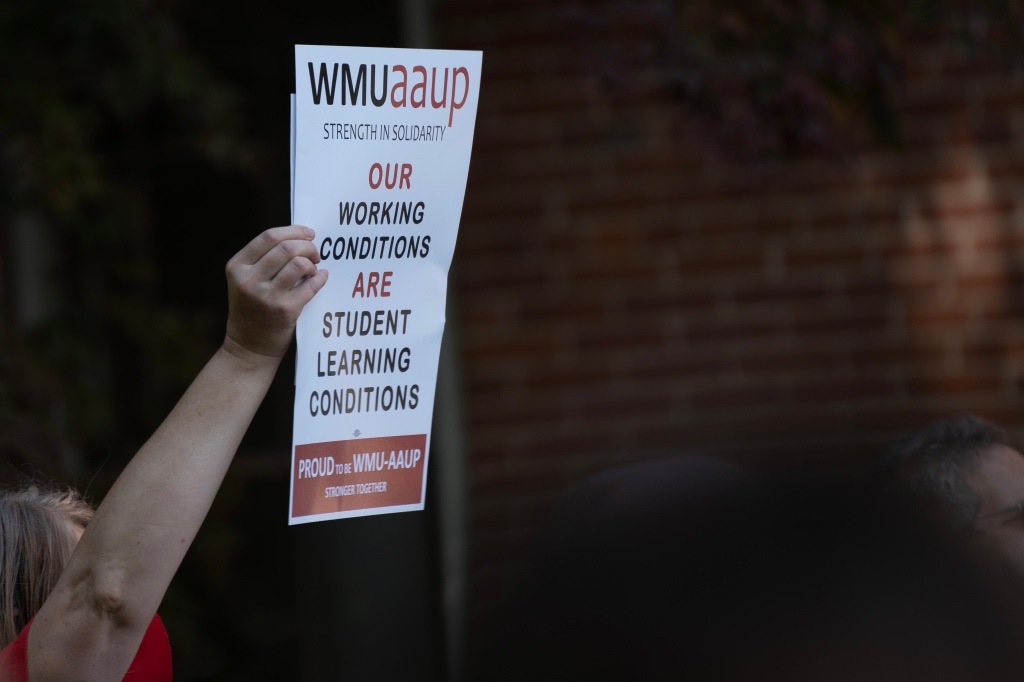
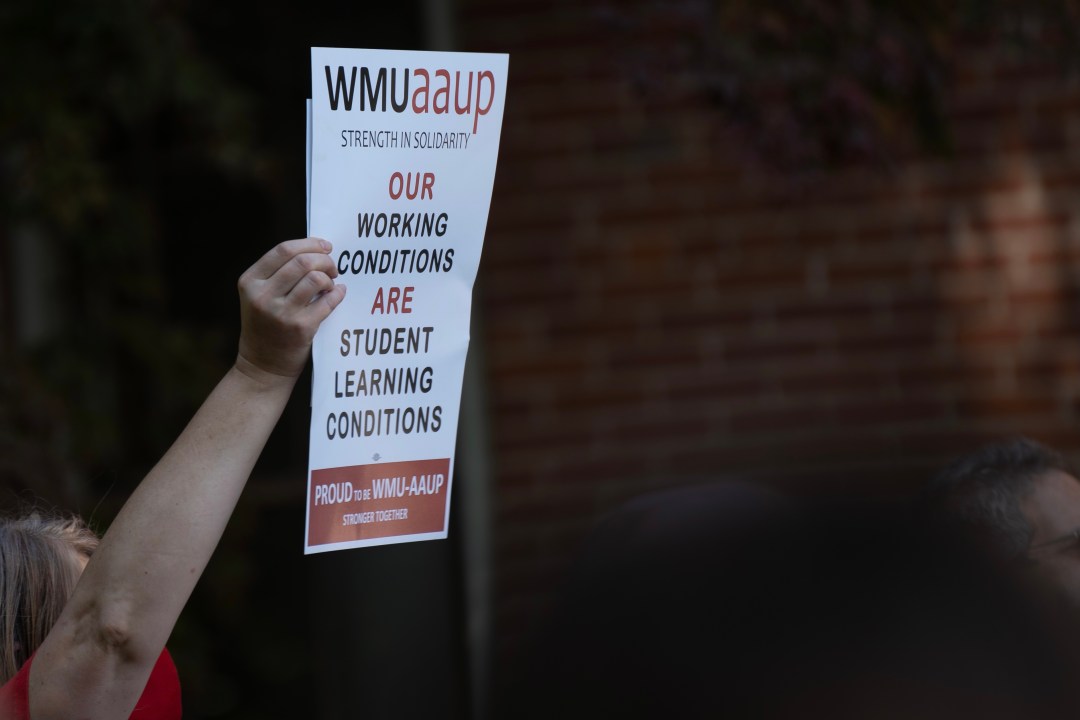
As 2024 WMU-AAUP negotiations kicked off last Thursday (June 13), Western faculty and allies gathered on campus to demonstrate their support for the WMU-AAUP Chapter negotiation team and for the process. Below are comments offered by the Chapter president and a few images from the event. If you were unable to attend, be sure to stop by Montague House to pick up posters, buttons, and other items. Remember, some of the terms negotiated by the WMU-AAUP will impact nearly every employee on campus!

Negotiation Kickoff Rally, Opening Remarks from WMU-AAUP President, Dr. Cathryn Bailey

Hello Colleagues and Allies,

I am so pleased to see here you here today, although I wish I felt more optimistic about what we should expect from the Western Michigan University Administration as these salary and healthcare benefits negotiations proceed. Unfortunately, I feel obligated to share with you my sense that this Administration is unlikely to agree to provide decent raises and affordable healthcare benefits unless we employees make it abundantly clear that we will accept nothing less. In short, no matter how compelling the WMU-AAUP’s arguments and evidence are, if this Administration continues to behave as it has been, then only our solidarity and stubborn determination will lead to the outcome that we need, and that our students deserve.

I’ll start out by making a few predictions about what probably WON’T motivate the Administration to do right by its employees. I’m inclined to begin this way because I know that we academics tend to be motivated by reason and evidence. Rational, evidence-based thinking is kind of our thing and it’s admirable that we believe so strongly in it. Unfortunately, one of my hardest won lessons in recent decades has been how little power reasons, evidence, and considerations of fair play have in many dealings with university administrators. With that said, here are some factors that probably WON’T be decisive during negotiations in the coming weeks.

⁃ First of all, the WMU Administration most likely WON’T do right by us and provide decent raises and benefits simply because it’s the ethical, or even merely sensible, thing to do. Certainly, there has been no indication from this Administration during the past few years that they have any qualms about the huge pay disparities between themselves and most other WMU employees. From what I can tell, this Administration is utterly committed to an ongoing reality in which they become increasingly wealthy—fed largely by our students’ tuition dollars —while any number of WMU employees are forced to work multiple jobs just to make ends meet. Again, this Administration doesn’t seem to think there’s anything objectionable about the gargantuan disparities between their salaries and ours, nor do they seem to appreciate that they could mitigate some of our criticism of them simply by offering fair raises. To the contrary, they have repeatedly held the line in various negotiations with employees, making lowball, insulting offers and stonewalling at the table.

⁃ Second, that Western’s academic mission is being starved by this Administration’s poor spending priorities is also unlikely to move this Administration to make reasonable offers at the table. In fact, when we look at the evidence—for example this Administration’s weird and shameful handling of the ongoing Faculty Research Travel Fund debacle—we see them bending over backwards to AVOID supporting Western’s research mission. Even as WMU continues to market itself as a research-intensive university to students and their families, the lengths to which this Administration has been going to avoid even its limited contractual obligation to fund faculty scholarship—and we’re talking about a relatively minuscule amount of money here—is stunning. What are we to conclude other than that this Administration either doesn’t care whether or not most faculty are able to succeed in their jobs, or that they simply expect us to pay for our work travel out-of-pocket, further diminishing our eroding salaries. I should add here that, at the same time, this Administration is quite happy to spend tons of money on their own travel, presumably because they think the work they do is more important for the university than what we do.

⁃ Third, this Administration probably still won’t even acknowledge that they actually do have the money to fairly compensate the faculty and other employees. The fact is that Western is in robust financial shape, sitting on impressive reserves, even as, year after year, it continues to dump jawdropping subsidies into Division I sports. Nonetheless, the likely scenario is that this Administration will sit across from our negotiation team and continue to claim poverty yet again this summer. And let’s be clear here, what we have effectively been told by WMU administrations FOR YEARS is that Western Michigan University can afford millionaire administrators and coaches, elaborate, endless construction projects, and, again, an embarrassing drain of resources into Division I athletics. However, WMU somehow still does not have enough money to properly compensate the professors, teaching assistants, part-time instructors, advisors, custodians, landscapers, and many other employees whose work makes Western work. As you may also have noticed, the Administration always seems to have a long list of excuses when asked about its (dis)investment in the university’s academic mission, never mind that students are among those hardest hit by such inappropriate spending priorities.

Of course, the WMU-AAUP will continue to point out the factual contradictions and ambiguities that underlie the Administration’s self-serving positions, but please understand how unlikely such arguments are to be compelling to them. No, we don’t yet know how things will go this summer—and we can certainly leave some space for hope and optimism—but I would remind you that just a few years ago, the Administration’s opening bid for faculty raises was an unprecedented zero percent. Zero. Zilch. Not one damn penny. And, to be clear, the Administration treated our academic labor partners —the PIO and TAU—similarly during their contract negotiations. This insulting approach to negotiations by the Administration was not business as usual—which would have been unpleasant enough—but an especially nasty shift in tactics, one in which they sent the message right off the bat about what they think academic laborers are worth. Zero. Zilch. Not one damn penny.

And as I prepare to conclude my remarks, I will reiterate the one thing that IS most likely to get this Administration to begin investing in the faculty again: They must understand that we will accept nothing less than a decent salary and benefits package. Period. They must be helped to appreciate that we are exhausted by their self-serving excuses and perverse spending priorities and will not be assuaged, intimidated, or hoodwinked into accepting anything less than what we deserve and need. To reiterate a slogan that has become one of my very favorites: United we bargain, divided we beg.

The WMU Administration’s reluctance to support its research mission: How Western faculty can respond

a message from WMU-AAUP President, Dr. Cathryn Bailey, and WMU-AAUP Vice President, Dr. Whitney DeCamp

We’re reaching out with time-sensitive information regarding the WMU-AAUP’s efforts to enforce the contract regarding funding for research travel. If you simply wish to learn more about what you can do to help restore travel funding, skip to the last section of this email. Otherwise, please review this full message to ensure that you’re fully up-to-date.

The backstory

As you may recall, in September of last year, we warned of draconian cuts by the WMU Administration that would result in absurdly low funding amounts, a shocking $133 per faculty member for the entire year. Although the Administration quickly rolled back part of this plan after a strong faculty reaction, it has continued to dispute faculty members’ contractual right to receive funding for two trips.

The Chapter’s position has always been that the contractual language regarding this matter is clear and unambiguous. Indeed, the most relevant sentence (in Article 34) states: “Faculty may receive travel support for up to two (2) professionally recognized meetings per year through the FRTF.” Nonetheless, the Administration denied the Chapter’s grievance filed in September regarding this matter, based, in part, on its (implausible) reasoning that “up to two” might be interpreted as just one (or even zero). When the Administration was unwilling to agree to follow the plain language of the contract, the Chapter submitted a demand for arbitration. This process includes review by a qualified third-party and would impose a legally binding solution on both parties.

While nearly everything about this process has been disappointing from our point of view—not the least the Administration’s dogged attempt to nickel and dime faculty who wish to fulfill their professional research obligations—we were further disillusioned by the university’s latest attempt to drag its feet. So, although the arbitration hearing was originally scheduled to take place this week, the Administration requested earlier this month that it be postponed. Although the Chapter objected to the delay, the delay was ultimately granted (and was accompanied by a steep rescheduling fee for the Administration). The summary, then, is that the Administration is continuing to drag its feet, creating ongoing hardship for faculty who need to plan and carry out professional travel.

What you can do

Reach Out to Faculty Senate Representatives: Even as the Chapter is following common-sense legal advice and eager to resolve this matter through arbitration, there is a memorandum of action (MOA-24/02) regarding this issue that is being proposed to be presented for a vote by the Faculty Senate at its meeting this Thursday. This MOA (among other concerns) contradicts our negotiated contract, which guarantees faculty the right to use the FRTF up to two times per year. There is nothing in the contract that makes the guarantee conditional on funding allocations set by the Administration, nor has that ever been the practice used in administering the FRTF. Although this MOA could not take effect without the signature of Chapter president—who has already indicated she will not approve it —we believe that it is unproductive for this MOA to even be considered at this time. Again, the WMU-AAUP is in the midst of legally-binding proceedings with the Administration to resolve this matter and so it would be untimely, at best, for a faculty body to vote on this MOA. With this in mind, we encourage you to reach out to your Faculty Senate representative to ensure that they are aware of all the facts regarding this matter. Encourage them to vote to table this MOA, if possible, until after the arbitration is resolved, or to vote no if necessary.

Preserve Documentation Regarding FRTF-Related Matters: We confirmed through the recent survey we conducted that many faculty have experienced a financial our-of-pocket impact of the changes to the FRTF amount and trip maximum. Even more have reported professional impacts that have caused them to change current or future travel plans as a result of the Administration’s unilateral changes to FRTF travel reimbursement. We are asking all faculty to preserve any documentation they might have about impacts, whether financial or professional (or both). This might mean documentation of expenses for non-reimbursed travel, evidence that other funding sources were unnecessarily drawn down to cover funding gaps, or even communications showing changes to research or travels plans (short-term or long-term). Please preserve these records, as they may be relevant if the arbitrator allows for compensation. The Chapter filed the grievance about this issue within days of the announcement, yet we will have waited nearly an entire academic year for a resolution as a result of the slowdowns forced on the process by the Administration.

As a faculty, we have many battles to fight to reverse the Administration’s shameful determination to decimate Western’s integrity as a research-intensive university. This contractual dispute is one such battle.

Laying the groundwork for successful salary and benefits negotiations

With WMU/WMU-AAUP negotiations set to begin early this summer, we’re eager to provide members and allies with all the information you need to help ensure that Western Michigan University faculty earn a fair salary, and that all campus employees secure the benefits they deserve. Remember, some of the key terms negotiated by the WMU-AAUP impact, not just professors, but nearly every employee group on campus.

The timeline and what’s on the table

Negotiations are slated to begin no later than June 15—just four short months from now—and will be restricted to two key contractual areas: Article 32 Economic Compensation, and Article 33 Health Care Benefits and Insurance. This is an abbreviated version of negotiations, then, what is sometimes referred to as a “wage reopener,” with the WMU/WMU-AAUP Agreement as a whole not expiring until 2026. 

The team and the nature of its work

The current negotiation team was selected according to Chapter bylaws through a process that began with a member-wide call for nominations and culminated in final approval by the Association Council (the WMU-AAUP’s body of department representatives). Our four-person team includes Dr. Andrew Hennlich (Chief Negotiator), Dr. Regina Garza Mitchell, Dr. Jean Kimmel, and Dr. Cathryn Bailey (WMU-AAUP President and Ex-Officio team member). The team meets regularly to discuss negotiation strategy, help coordinate research related to salary and benefits, seek member input, and to undergo training and development. Of course, once negotiations actively begin, the team will sit across the table from WMU’s team (as yet to be announced) to negotiate faculty salary and benefits.

Member input/college visits, survey, and more

The process of collecting member input about negotiation concerns is ongoing, with the Chapter continually updating its file about what members think should be prioritized. In addition to encouraging members to reach out at any time to share their experiences and offer insights, visits by team members and Executive Committee members are currently underway in individual colleges. In addition, a detailed survey vetted by the team, focused on questions about salary and benefits, was circulated to members by email recently, providing a convenient opportunity to share detailed input.

Show your pride and support

In the coming weeks and months, there are a number of ways you can support negotiations and help lay the groundwork for success. 

  • If you’re a WMU-AAUP member, make sure you know who your department representative is. If your unit has an open seat, ask to be considered by your colleagues to serve in this role or encourage a qualified colleague. Having active representation on the Association Council is never more critical than during negotiations.
  • Stop by Montague House (814 Oakland Ave.) from 10-12 most business days to pick up posters, stickers, and more so that you can show your pride. Alternatively, let us know if you’d like us to mail you these materials directly. 
  • Order a WMU-AAUP t-shirt and be prepared to wear it in solidarity with colleagues to help send a message of solidarity. The link to order is here
  • Be sure to follow the WMU-AAUP on Facebook, visit our blog and our website where you’ll find tons of valuable information, including the WMU/WMU-AAUP Agreement and contact information for officers and representatives.
  • Stand ready to participate in all actions and initiatives as this process unfolds, keeping in mind that our power lies in the demonstrated solidarity of all of us! 

WMU radically cuts research support despite significantly improved financial picture

A message from WMU-AAUP President Dr. Cathryn Bailey, and Vice President Dr. Whitney DeCamp

We’ve been hearing a lot of good news lately about research achievements, enrollment, and state appropriations. Whether or not the picture really is so rosy, you can imagine our surprise at the University’s stepped up plan to slash support for faculty scholarship. New amounts for travel and scholarship support have been established according to WMU’s website, and here are the dollar figures for the support funds that are accessible to all faculty.

• Travel (FRTF): $133

• Publication and exhibitions (PPP&E): $13

Keep reading to learn more, but don’t expect these shockingly low numbers to change as you read on.

Historic Achievements

In the September 14 update on enrollment, President Montgomery noted a “historic graduate student enrollment increase,” as well as various indicators of improvements in enrollment retention, and the “smallest decline [in enrollment] in more than a decade.” This, combined with the 6.4% increase in Michigan state funding for universities all suggest good news in terms of finances at WMU. Even on research specifically, things are (were?) looking up.

Scholarship takes different forms across the many disciplines, so it is difficult to quantify. It would be impossible, for example, to count all the research, creative activities, and other forms of scholarship and produce a composite measure of achievement. Dollars, of course, are easier to track, and more often reported by the university. Here was what President Montgomery had to say in his August 30 email about funded research over the past year:

“Externally funded research expenditures soared in fiscal year 2023, totaling $35.3 million—a 24% increase over FY22. Expenditures have not been this high in at least the past 21 years. Moreover, total awards hit $41.9 million, which is an 18% increase over the previous fiscal year.”

It sounds great. But, rather than match the “soaring” increases in funding with increased funds for faculty, we are seeing historically unprecedented cuts. With apologies to the late Justice Ruth Bader Ginsburg, bragging about historic research achievements and then cutting support for research “is like throwing away your umbrella in a rainstorm because you are not getting wet.”

Massive Cuts to the Support for Faculty Research, Scholarship, and Creative Activities

The webpage for the Faculty Research Travel Fund (FRTF) was recently updated to show the allocation of money each qualifying faculty member can expect with certainty:

“The initial reimbursement level for 2023-24 is $133. Per Memorandum of Action (MOA) 03/10, this is the total FRTF budget divided by all eligible bargaining unit faculty. If funds remain at the end of the fiscal year, it will be proportionally divided among faculty members who had approved travel, up to the amount of actual travel expenses.”

In case you think that number might be a typo, it’s worth noting that the webpage for the Final Preparation and Publication of Papers and Exhibition of Creative Works Fund (PPP&E) also shows an embarrassingly low amount:

“The initial reimbursement level for 2023-24 is $13. This is the total PPP&E budget divided by all eligible bargaining unit faculty. If funds remain at the end of the fiscal year, it will be proportionally divided among faculty members who had approved applications, up to the amount of actual expenses.”

Both websites newly refer questions about the funding amounts to “be directed to your RPC representative.” However, the Research Policy Council, a Faculty Senate committee, is not responsible for deciding how much funding the Administration allocates overall to the Faculty Research, Scholarship, and Creative Activities Support Fund. That decision rests exclusively with the Administration.

Here are the four relevant funds, including the two competitive funds, and the award amounts for fiscal year 2023-24:

• Travel (FRTF): $133 (down from $2,500)

• Publication and exhibitions (PPP&E): $13 (down from $2,000)

• Faculty Research and Creative Activities Award (FRACAA): $10,000 (down from $15,000)

• Support for Faculty Scholars Award (SFSA): $2,000 (down from $3,000)

WMU has not provided aggregate budget totals, but the dramatic decrease in the total funding available from the Administration is self-evident from the figures above. Knowing that there are approximately 760 faculty as of this post, some inferences can be made about the funding amounts listed. If the minimum guarantee of $13 for publication and exhibitions was distributed to each faculty member, that would mean that WMU has allocated $10,000 total for that spending bucket. Compare this to the $61,039 distributed for publication and exhibition in fiscal year 2022-23. Similarly, the much more widely used fund for faculty research and travel would appear to be capped at about $101,000 for this year, with $133 the minimum guarantee per faculty. Contrast that figure with $367,961, the 2022-23 fiscal year expenditure for faculty research and travel.

The phrasing on the website promises that unspent funds will be proportionally divided among the recipients at the end of the fiscal year (June 30, for anyone wondering how long it might take for reimbursements to be processed). Whatever number that ends up being, it will clearly be massively insufficient if the two funds are slashed down to tiny fractions of the previous years expenses – 16% and 27% by our calculations. This is in addition to the logistical and practical nightmare for faculty who want to publish, exhibit, and travel, but won’t be able to assess the level of support from WMU.

A June 23 email from Dr. Remzi Seker, Vice President for Research and Innovation, referred to $300,000 being the “recurring budget” for the Faculty Research, Scholarship, and Creative Activities Support Fund. Whatever was meant by “recurring,” the figure is far less than typical. In the decade prior to the pandemic, the typical annual WMU allocation was $475,000. It appears, based on available information, to have never dipped below $445,000 between fiscal years 2009-10 and 2019-20. With rising costs, support for faculty research should be increasing commensurately. Instead, not only has WMU failed keep up with inflation, administrators have now further drastically slashed support. Whether the total amount provided is $300,000, or perhaps a more generous $350,000, or even some other slightly better figure, it fails to live up to the historic standard, which was never overly generous in the first place.

How much longer can WMU continue to claim to be a research institution if it is not willing to spend as much on the research support fund for the entire faculty body as it spends on the salary and benefits for a single executive administrator? Will administrators be subject to the same constraints being placed of faculty? Perhaps a new Vice President for Saving Money could investigate further.

The crisis here is not just for individual faculty seeking to fund their professional expenses, or faculty members calibrating professional decisions to an amount they can subsidize with their personal savings. That is bad enough. But the crisis is one of WMU’s increasingly suspect claim that we are an institution that values research and that our trajectory as an institution is one of soaring excellence.

Impact

With only $133 in guaranteed funding for research travel, how will faculty continue to present at and attend conferences? In most professional associations, this is not even enough to cover the registration fee, let alone airfare and lodging. (Actually, $133 is the per diem rate to reimburse a one-night hotel in city such as Detroit or Houston; places such as Chicago, New York, and San Francisco tick up to as much as $330 for one night’s stay.) Some departments can provide (small) additional support, but even then the amount varies substantially and creates further inequity between the disciplines. The fact is that this change will result in most faculty being forced to either pay for their travel themselves, or simply discontinue attending conferences. Surely the Administration will be disappointed when research productivity drops in subsequent years as faculty miss out on a vital component of networking, learning, and collaboration.

Likewise, with publication models shifting in favor of open access publishing, the effective discontinuation of support will decimate the ability for faculty to publish in open access journals. Although there are many journals that allow an author to select the old subscription-based model, the changing market makes that choice counterproductive: fewer people will read the publication, and the research will therefore have a smaller reach. The fund is also designed to support the exhibition of creative works, and an amount of $13, probably less than you give your teenage kid in lunch money for a week, is absurd.

In addition to how this affects scholarship productivity in general, we also must consider how this affects some faculty differentially. Who is most likely to see paying for travel themselves as necessary? We would assume it will be our untenured colleagues, who are evaluated on their scholarship at regular intervals, with positive reviews needed in order the keep their jobs. These early-career faculty are among the lowest paid and most vulnerable faculty – and among the most likely to seek jobs elsewhere if they are inadequately resourced at WMU. One faculty member, upon hearing the news about travel funding cuts, texted a friend at another university to vent. The friend replied with a description of the support they get, and a link to a posting for an open position at their university. How can WMU retain its faculty under these conditions?

This is certainly obvious to any faculty member reading this, but it should be highlighted that this issue, although financial, is not about salary or benefits. The ability to publish articles, to exhibit creative work, to present research at conferences, and to engage in other forms of scholarship is not, as a human resources perspective might say, a “benefit.” These are the tools needed for faculty to do their jobs and fulfill the university’s research mission. Not only do we individual faculty members deserve better, then, but so does our entire university. As a research-intensive university, Western Michigan University cannot afford to make such shortsighted, irresponsible fiscal decisions.

Academic freedom under attack at WMU: Administrative abuse of the disciplinary process

A message from WMU-AAUP President Dr. Cathryn Bailey, and Vice President Dr. Whitney DeCamp

When Western Michigan Professor Jackie Marvin (not her real name) received notice a few years ago that the administration was initiating disciplinary proceedings against her, she was stunned and confused. “I knew I had done nothing wrong,” she said, “but this very official letter from the administration, out of the blue, implied — without providing any details — that I was guilty of serious misconduct.” Ultimately, the matter was dropped, according to Dr. Marvin, with no evidence for the allegations ever provided, but the impact on her was devastating and lasting. “Ever since, I was basically walking on eggshells, knowing that, at any moment, they might be getting ready to drag me through another nightmare.”

It is in response to such ongoing and increasing abuse by WMU of Article 22 of the WMU-AAUP Agreement that the Chapter is redoubling its efforts to address this matter. Although we have repeatedly and urgently brought this concern to WMU’s attention over the past many months, the situation has actually become worse. To summarize, since the start of 2023, at least seven professors have been dragged into the formal disciplinary process, a staggering figure.

Another truly disturbing fact, however, is that in at least five of these cases, the targeted faculty member apparently received no communication about the concern from their chair (or other appropriate administrator) prior to being thrust into the formal process. The new approach of Academic Affairs seems to be that, when a complaint or concern arises, the presumption shall be that the faculty member is likely guilty of serious misconduct. The upshot is that, for the first time in history, the policy of Academic Affairs regarding such concerns — including straightforward student complaints — seems to be to launch a formal stressful, frightening, and time-consuming contractual process against professors. This is in addition to the separate very serious problem of the failure to provide appropriate evidence in many of these cases, which also urgently needs addressing.

In most of these instances, it is evident that a simple conversation would have cleared up misunderstandings. An informal, collegial discussion of concerns with the faculty prior to taking formal action — as had historically been WMU’s norm in most cases— is a contractually recognized part of the process (22.§1.2) precisely so as to avoid unnecessary escalation. The unwillingness of some administrators to discuss concerns with faculty in their units, and the enthusiasm of other administrators to unnecessarily drag faculty members through this intimidating formal process exacerbates many ongoing problems, including our university’s morale crisis.

Not only is the casual, liberal application of the formal disciplinary process a further assault on Western’s already fragile campus morale, it also undermines professors’ ability to do their jobs. So long as any WMU faculty member fears that they too might be swept into the disciplinary process as a result of a passing complaint — by a student, employee, or administrator — they are not free to flourish as academics. Although WMU has not yet been in the news for top-down attempts to intimidate or retaliate against faculty as, for example, has happened in Florida and Texas, Western is on a similarly problematic trajectory given its increasingly liberal application of this key contractual article, the integrity of which is essential to maintain robust campus speech, academic freedom, and faculty and student morale.

Last Summer and Fall, we and several WMU-AAUP officer colleagues made repeated efforts (throughout administrative personnel changes) to explain the serious implications at WMU of invoking Article 22. And we have done so repeatedly in the months since then. Over and over again, we have explained both the ethical and practical imperatives for following the norms of academic culture with respect to addressing the numerous inevitable complaints and concerns about faculty that arise on all university campuses. This makes it especially alarming that, in the first year with a new Academic Labor Relations Director, the WMU-AAUP is dealing with a deluge of hasty and frivolous “disciplinary” cases. As we watch the precipitous and authoritarian attacks on faculty rights around the nation, the conclusion we must draw is that an escalated response from the WMU-AAUP has become necessary.

Commencement at WMU: Part celebration and part administrative performance

A message from WMU-AAUP President Dr. Cathryn Bailey

For university employees, graduation season can be one of the most meaningful times of the year. Many of us have worked closely with these students, sometimes for years, and so we often share directly in their relief, joy, and pride as they prepare to claim their degrees. But commencement day itself is also part of the big business of higher education, with meticulously choreographed and precisely scripted ceremonies aimed at portraying the institution in the best possible light. Commencement is not just a celebration; it is also meant to attract new students and to provide public reassurance that, in an increasingly cutthroat enrollment environment, Western Michigan University is well-led and well run, that it can be counted upon to fulfill the promises its administrators make to students and their families.

When pressure is put on faculty and staff to directly participate in the pomp and circumstances of commencement, it’s usually implied that this is a responsibility we owe to our students and institution. The suggestion is that, regardless of the problems we may be dealing with as employees, on this special day, we should enthusiastically line up behind the president, vice presidents, provost, vice provosts and other dignitaries. A failure to join in the pageantry may even be criticized by administrators as an act of disloyalty to Western. This is not surprising, as university administrations depend upon an enthusiastic show of campus support on commencement day to lend credibility to their own leadership. Regardless of how chronically overworked, disrespected, ignored or trivialized they may feel, then, the assumption often is that it is employees’ duty to shine their shoes and help fill out the performative tableau of the university as one big happy family.

It surely makes sense that for some employees and students, feelings about commencement may be especially complicated, especially when serious campus problems have gone unaddressed by the Administration for years, problems that ultimately impact our students and their families most of all. It can feel false and hypocritical to repeatedly participate in the ceremonial performance of responsive and effective leadership when the day-to-day reality often tells a different story. Certainly, some employees may feel as if their role in students’ academic success is recognized by the administration only from the commencement stage. When the president asks the faculty to stand to be acknowledged by the audience, for instance, it can feel genuinely moving. But as soon as the lights go down, it’s back to business as usual, a sobering reality in which some of the most frequent faculty inquiries to the WMU-AAUP these days are from faculty who want to resign their positions.

As someone who’s been attending commencement ceremonies off and on now for about 35 years, I can personally attest to my increasingly mixed feelings when I am invited to share the stage with university administrators, ostensibly to show support for our students and our university, but, evidently, also to serve as a tacit endorsement of their leadership. And, frankly, for the past several years in particular, my joy for successful students and colleagues has become increasingly tinged with sorrow for those who, due to chronic, preventable and predictable leadership failures, are not here.

At this joyful time, then, I grieve for the students who:

• transferred out after one semester or one year because precipitous and unnecessary staffing cuts to advising, financial aid, counseling and other key offices left them feeling underserved

• dropped out because increasingly overworked faculty, teaching assistants, and part-time instructors were challenged to provide these students with the close scholarly collaboration for which they had initially chosen our “student-centered research-intensive university” over competitors

• left because, as BIPOC and/or LGBTQ+ individuals, they had begun to feel doubt about WMU’s ongoing commitment to their academic success and well-being

• never matriculated at Western in the first place because of ineffective top-down branding schemes, uncompetitive graduate student funding, or admissions delays due, again, to preventable staffing shortages

And I grieve for the faculty and staff colleagues who:

• have resigned or prematurely retired because shortsighted, unnecessary budget cuts have made it impossible for them to care for themselves and their own families while continuing to serve students to their full potential

• have resigned or prematurely retired because they have been on the receiving end of unskillful or unethical administrative interventions, including top-down program changes and inappropriate disciplinary actions

• have resigned or prematurely retired because they lost hope in the administration’s desire or ability to heal our university’s well-documented morale crisis, especially in the wake of the Vote of No Confidence

• feel so estranged and alienated as a result of some of the university’s priorities, policies, and practices — including some related to the “new” SRM budget model — that they feel less able to participate in our university’s public celebrations

These are just a few examples of students, faculty, and staff who will not be attending commencement. They will not tear up at the video montage of family tributes to our lovely students. They will not laugh at the president’s corny jokes or totter proudly across the stage in impossibly high heels to claim their diplomas. They will not mingle with joyful friends or colleagues before and after the ceremony on the sunny Miller plaza.

As our great, but troubled university publicly performs a celebration for those whose hard work and good fortune propelled them to the finish line, who will stand in solidarity with these ghosts and shadows of absent colleagues and students? And if this administration cannot be persuaded to take decisive and substantive action to heal and repair our university after the stage has emptied and the regalia has been stowed away, who will be left to fill the auditorium next year and the year after that?

Western Michigan University quietly directs $2.8 million to yet another private consulting firm

The messaging from the Western Michigan University administration has remained remarkably consistent over the past decade or so: Due to a supposedly chronic financial crisis related to shrinking enrollments, employees must continue to tighten their belts and redouble their efforts to prove their value to the university. The so-called “SRM” budget model is the latest installment in the financial scarcity narrative – a framework being used to justify staffing cuts, program mergers, and various austerity measures ostensibly aimed at creating a more streamlined and efficient WMU. In the midst of this permanently declared state of budget emergency, however, the administration has also remained committed to directing jaw-dropping sums of money to corporate consultants to facilitate strategic planning. The latest beneficiary – this time to the tune of $2.8 million – is McKinsey & Company, a private-sector, non-academic business consultancy whose mission is “helping our clients create meaningful and lasting change.”

To those who have been at Western for more than a few years, this will not come as a great surprise, as our university has increasingly come to rely more and more on exorbitantly expensive external agents to solve its problems or to enact high profile administrative initiatives. So, for example, in 2020-2021, WMU contracted the non-academic consulting firm Designvox to help facilitate/implement the administration’s academic (“interdisciplinary”) restructuring plan. Based on copies of invoices provided to the WMU-AAUP Chapter, the administration authorized this firm to review proposals related to curricular and program changes that had been developed and submitted by WMU faculty. It is understandable if you do not recall the results produced by Designvox given that the entire initiative seems simply to have dissipated from the radar at some point.

Campus constituents have, of course, been highly critical of such decisions. How can the WMU administration and our Board of Trustees justify quietly spending millions on external non-academic consultants for yet another strategic planning process while starving the university’s academic core? Why bypass or ignore proven academic experts – including from among our own faculty – in favor of an expensive professional consultancy firm with no clear, significant evidence of academic expertise? This last question deserves special focus since information about any experience McKinsey might have with universities seems to have been specifically redacted by the WMU administration in the documents we have been provided.

Western’s administration insists that it is only after enrollment numbers improve that we can expect real investment in our university’s academic infrastructure. No doubt, firms such as McKinsey are being engaged to provide some sort of corporate “synergy” to, once again, make our university a destination of choice. However, as staff and faculty have repeatedly pointed out, unless and until Western invests in the people charged with carrying out its core mission, there is little hope of attracting and retaining students in a way that is sustainable. The fact that our administration is willing to write a $2.8 million check to yet another corporate consulting firm while urging students, faculty and staff to keep tightening our belts speaks volumes about our university’s morale crisis.

Sixteen months after WMU’s No Confidence Vote: Have things gotten better at Western?

A message from WMU-AAUP President Cathryn Bailey and Vice President Whitney DeCamp

It has now been sixteen months since the Board-appointed faculty at Western Michigan University overwhelmingly voted to approve a vote of no confidence in WMU’s President. Despite this clear message demanding change, and ample additional evidence of a morale crisis as demonstrated by a Faculty Senate survey and the administration’s employee engagement survey, the president remains in his position. Further, with the exception of a new provost, the cast of supporting characters — including most of the vice presidents, associate provosts, and deans — also remains largely unchanged. As another academic year winds to a close, this is a good time to take stock of where we’ve come over the past year and half or so.

Although the perspectives of individual faculty, staff, and students will obviously vary, from our point of view, many of the concerns expressed by the no confidence vote remain largely unresolved. A few are especially worrisome because they represent not merely discrete problems that might be addressed through targeted policy changes, but an ongoing corrosion of the foundation of Western’s campus culture. For example, leadership’s “failure to respond appropriately to feedback and concerns” and the “unprecedented narrowing of the practice of shared governance” are higher order, systemic deficits that make more specific problems — for example, enrollment challenges — much harder to address. Moreover, leadership failures that continue to damage WMU’s status as a “great place to learn and work,” create a vicious cycle of campus dissatisfaction, making our university less attractive to new talent and energy that might help to renew and reinvigorate it.

Despite some modest improvements in some areas of enrollment data last year, cause for concern has remained steady or grown in other important areas, including:

– After the precipitous layoff of numerous key employees a few years ago, chronic under-staffing and problematic hiring delays.

– Further violations by WMU of shared governance and due process in its pursuit of rapid restructuring and in other decision-making.

– The administration’s refusal to take basic steps to assure impartiality in the grievance process, further undermining confidence that faculty concerns will be fairly considered.

– A lack of transparency, for example, about challenges regarding the new student center.

– Unacknowledged implications of the new “competitive” budget model on the curriculum and the research mission.

– A failure by WMU to accept the Chapter’s repeated invitations to initiate discussion about the possibility of adding Juneteenth as an official holiday to the university calendar in response to state and federal recognition and student requests.

– An over-reliance on the formal disciplinary process to address concerns about faculty job performance and a failure to properly adhere to the process, for example, to provide evidence for allegations of misconduct.

– A squandered opportunity to more fairly and rationally address salary equity adjustments through WMU’s failure to collaborate effectively with faculty in the negotiated “salary equity committee” last year, and in its ongoing failure to accept overtures to continue that committee work.

– Ongoing enthusiasm by WMU to rely upon attorneys to handle employee concerns and to escalate issues unnecessarily, for example, the summer preference grievance that was decided in the Chapter’s favor through a time-consuming and expensive arbitration process.

As we noted in message of March 3, 2022: “Obviously, WMU’s current employee morale problem can’t be resolved through a single action or in an instant. However, there are any number of things that WMU leadership could do, if, indeed, they were willing to admit that this problem exists and at increasingly alarming proportions.” Although the WMU administration has made some welcome gestures toward reconciliation with employees over the past 16 months, it seems like they’ve just given up when it comes to some of the most substantive concerns. Also, as we have noted previously, at some point, ongoing listening and data collection seem like an excuse for failing to act when information has already been repeatedly provided.

Further, to be clear, in addition to the input faculty and staff have provided through numerous forums and surveys, the WMU-AAUP leadership has continued to convey faculty concerns to the administration. Far too often, however, the response is one that seems calibrated to highlight the administration’s managerial prerogatives over employees rather than its service and leadership responsibilities to them. It’s an unproductive scenario in which the elected leaders of Western’s faculty, teaching assistants and part-time instructors are likely to receive rebuttals rather than understanding from WMU administrators when we share our colleagues’ concerns.

It was, of course, disappointing that, after the faculty’s historic resolution of no confidence, the WMU Board of Trustees’ response was, at least publicly, to double-down on its support for the president and the status quo. This included approval of presidential raises and bonuses that, to some campus employees seemed not just exorbitant, but insulting. After all, the Board took these actions even as faculty and staff were being lectured by the administration about the ongoing need for belt-tightening. Still, things might have unfolded differently. The resolution might have been received by the administration as a wake up call, an invitation to reflect unflinchingly on its record and to embrace every opportunity to restore campus confidence.

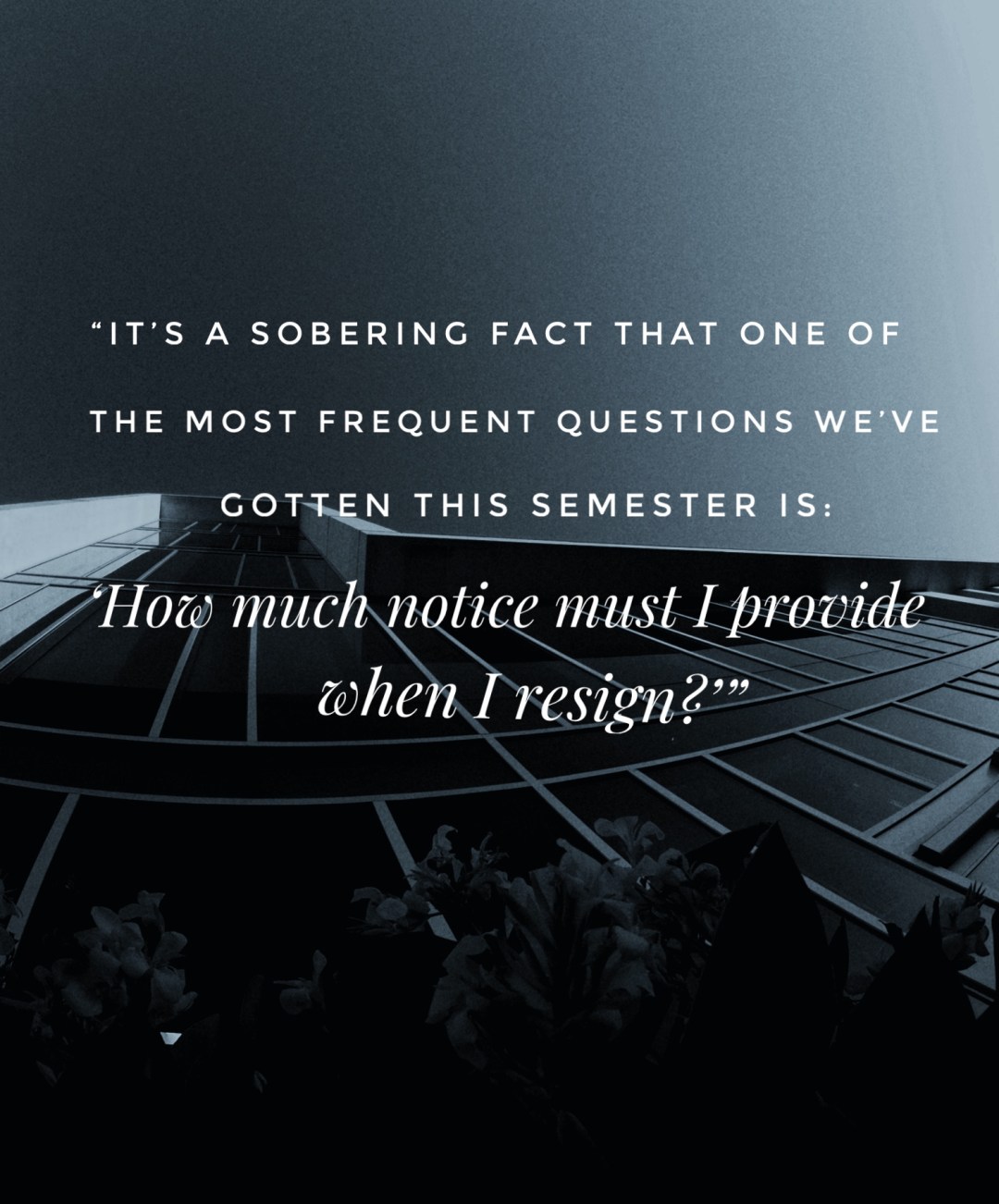
As dramatic as the December 2021 faculty resolution itself was, then, what is almost more noteworthy than that event itself is the administration’s ongoing failure to provide healing and responsive leadership since then. It is a sobering fact that two of the most frequent questions we have received this semester are: “How much notice do I have to provide when I resign?” and “How long will my benefits continue once I resign?” It seems that not only has our campus morale not been improving, it may actually be getting worse as time passes and hope fades.

WMU’s growing reliance on attorneys to deflect employee concerns

A message from WMU-AAUP President Cathryn Bailey and WMU-AAUP Vice President Whitney DeCamp

There is nothing new or especially problematic about universities calling upon legal experts, especially in limited contexts where it may be necessary to protect institutional interests from external threats. But there is a meaningful difference between the occasional use of legal counsel to safeguard the institution and the increasingly common use of attorneys by Western Michigan University in an ever-expanding scope of internally-directed functions. Not incidentally, some of these are functions that, until recently, have been more commonly performed by administrators with faculty rank, not by lawyers.

An example about which the WMU-AAUP has repeatedly expressed concern is the university’s hiring of the aggressive, anti-union law firm Dykema Gossett to represent management interests in various matters, including in contract negotiations. Indeed, one of most noteworthy points about WMU’s recent labor negotiations was the administration’s decision to spend hundreds of thousands of dollars in an attempt to intimidate employees, in part, into accepting lowball salary offers. Not incidentally, WMU’s chosen Dykema attorney has been characterized by Michigan AFT president David Hecker as notoriously aggressive and anti-labor. “Any university who hires this guy,” says Hecker, “is sending a very clear and deliberate message to its employees.”

In addition, Western also employed this same attorney last year for an arbitration battle with the WMU-AAUP that the university decisively lost this past November. You can review the dressing down that the Western administration received by the arbitrator here. Although faculty rights to summer pay were ultimately protected as a result of the Chapter’s staunch advocacy, this is a good example of yet another unnecessary, lawyer-laden escalation by the university. The ultimate result of the university’s handling of this contract dispute? Tens of thousands of dollars diverted by Western to private attorneys even as campus employees were being lectured about the need for ongoing belt-tightening. In addition, there was a hit to morale from this administrative effort to deprioritize faculty in teaching, purportedly to offset SRM budget pressures (the stated reason for the attempted changes).

Yet another novel use of attorneys occurred last spring when WMU hired a Grand Rapids attorney to investigate unspecified accusations of wrongdoing by faculty members across two colleges rather than following the negotiated, contractual process for addressing such concerns. Although these faculty were directed by the former interim provost to meet with this attorney — and the Chapter president is among these individuals — few faculty chose to participate (consistent with advice provided by WMU-AAUP legal counsel). Nonetheless, the university administration has continued to appeal to this outside attorney’s report as justification for its adverse treatment of faculty, both in its informal communications to the Chapter and in official responses.

Until last summer, WMU’s Director Academic Labor Relations — a pivotal office for dealing with the concerns of faculty, teaching assistants, and part-time instructors — had always been appointed from among the WMU faculty. This was not accidental, but a recognition of the university’s desire to facilitate diplomatic solutions among folks who were more or less on an equal plane and who had shared understandings of academic goals and values. Appointing faculty members to this critical administrative role had been an imperfect, but generally effective means of avoiding the stress, rancor, and expense of unnecessary escalations and conflict when employee concerns and complaints arose. Now when the Chapter raises concerns about the impact an action will have on faculty morale, working conditions, or faculty/administrator relations, we are met, not with the understanding of a colleague but with legalistic responses, for example, a demand that we cite relevant caselaw that would require the administration to respond to such concerns. Anyone who’s been on the receiving end of such messages from attorneys — and emails from this office are now identified as coming from an attorney —can confirm that they often seem deliberately designed to intimidate.

It’s also worth noting that, while Western has long kept in-house attorneys on its payroll to represent the university’s interests in various matters, in recent years, these attorneys too have been pressed into service in novel ways. A few years ago, for example, the university determined that its in-house lawyers could now be construed as “administrators” who could directly participate in the hearing of grievances. Instead of the chairs, associate deans, or deans who would normally have been assigned to hear an employee or Chapter concern on behalf of the administration, then, faculty members might be confronted with a university attorney in that role. Although the Chapter successfully beat back this practice in 2021 by negotiating additional contract language, WMU’s determination to insert lawyers into the grievance process like this confirms a troubling trend.

It is puzzling to us that, even as WMU leaders insist they are sincerely trying to address the campus morale crisis, they are paying attorneys to respond to some of our university’s most human problems and concerns. Increasingly, when faculty, staff, and student employees reach out to our leaders, seeking understanding, compromise, and resolution, we’re being directed to sort it out with attorneys. This is, perhaps, not surprising since a layer of attorneys can serve as a smokescreen behind which administrators attempt to avoid responsibility. But such a wall of paid legal technocrats also keeps members of the university community from meaningful connection with our leaders about some of the issues that matter most. While the attorneys who are profiting from this arrangement may have cause for celebration, it’s a terrible loss for just about everyone else. Does anyone really believe that adding more lawyers to the mix is the best way to restore campus morale and Western’s status as a great place to work and learn?

WMU rolls out its controversial new budget model

A message from WMU-AAUP President, Dr. Cathryn Bailey, and WMU-AAUP Vice President, Dr. Whitney DeCamp

As WMU’s determination to implement its controversial new SRM budget model forges ahead, apparently on schedule, grave worries and concerns are beginning to pile up. This is not a surprise given that the model places still more pressure on employees even as our campus morale crisis continues to simmer. At the very same time that faculty and staff report being under-appreciated, unheard, and, in some cases chronically under-resourced, they are being urged to “reach deep,” to innovate, to grab the reins and solve WMU’s supposed financial problems and enrollment woes all under the SRM banner.

At the WMU-AAUP, we have been sharing concerns about the once-trendy “RCM” or “SRM” budget models for a while. Although SRM advocates champion the supposed flexibility and motivation this model provides to individual colleges, the predictable result is often a hunger games scenario. Accordingly, and what’s now happening at WMU: under the tacit or spoken threat of elimination, faculty are forced to prove their short-term value and worth, competing against one another for precious students, credit hours, and resources simply for the privilege of advancing into yet another round of kill-or-be-killed.

The practical problems with the SRM models are legion and very much in line with concerns being shared with us by our faculty and staff colleagues:

* As colleges are pressed to generate revenue in ever tightening circumstances, individual departments and employees are being tasked with solving the enrollment problem. Counterintuitively, at the same time the faculty are being starved of resources, we are being prodded to move faster and faster.

* Individual units and employees are being held responsible for solving institutional and systemic problems, sometimes under the guise of shared governance. As one faculty member colleague recently put it: “We’re not just being asked to do more with less. We’re being asked to perform magic because some of the higher ups have given up on addressing the problems themselves.”

* The integrity and value of the institution as a whole is placed in jeopardy in the supposed service of rewarding innovative and profitable units. There is renewed pressure on colleges and departments to come up with short-term efforts to attract students even as WMU’s basic academic infrastructure creaks, groans, and crumbles after years of neglect. Although SRM “subventions” are supposed to protect the university’s core commitments, the reality as it begins to unfold tells a different story, a competitive free-for-all with permanent damage to the core academic infrastructure.  

The fact that the practical and logistical problems of the SRM model are so ubiquitous may be why our campus community has not, as far as we know, ever been presented with actual examples of true peer institutions where the model has been implemented to good long-term effect. Instead, we have been provided with slogans and cheerleading, appeals to “innovation,” “creativity,” “autonomy,” and the like. Again, the basic message seems to be that if Western is to address its enrollment problems and its purported attendant financial scarcity, it is ultimately up to “us” to do it, even in the midst of gross staffing shortages that impede basic operations all across campus.  

That is, there is further pressure on individual faculty members, instructors and teaching assistants — most of whom are already committed to innovation and the development of responsive curricula — to create trendy new courses and programs so compelling that they will draw students from around the world. It is up to individual landscape workers and dining services employees to make campus so beautiful, and keep students so well fed, that they will stay. It is up to individual counselors and academic advisors to forge such deep personal connections with each individual student who crosses their path, that the student will feel “at home.”

Not only are we being asked, as individuals, to take on the responsibility of whether WMU, as an institution, thrives or fails — and this is in addition to the actual jobs we were hired by the university to do — the SRM rhetoric implies that we are anachronistic and irresponsible if we fail to rise to the occasion. Indeed, if we were cutting edge, energetic go-getters, it is often suggested, then we would be celebrating all of the supposed newfound economic, entrepreneurial “independence” rather than “complaining” that we’ve now been tasked with enrollment management.

It is, of course, true that individuals play an important role in shaping our university’s future. The fact that Western employees understand this is precisely why WMU has been doing as well as it has after decades of budget cutting. Most of us have been working incredibly hard even in increasingly difficult circumstances. But, it feels like gaslighting for employees who have been marginalized from so much critical decision-making over the years — for example, branding, identity, and fundamental budgetary values — to have potential institutional failure placed on our shoulders.

Although this is not a sexy idea, our position remains the same: Western Michigan University’s long-term success as an institution depends on its willingness to invest in the basic quality of its core academic mission. Innovation is great, and something faculty do exceedingly well. But there are no magical quick fixes to transform our university into a magnet for students across the region or around the world. To succeed intact as an institution over the long haul, WMU must draw a line in the sand and decide what it truly values rather than pursuing slogan-based gimmicks.

As we have repeatedly demonstrated, including during the last round of negotiations in 2021, WMU does not have a budget crisis so much as a budget priority crisis, one that seems to have placed Academic Affairs in a chronic state of artificial financial emergency. It is one thing to experience austerity during times of genuine material scarcity. It is quite another to know that, at least in part, such neglect is the predictable result of avoidable financial choices. Unless and until Western’s leaders — especially its president and its Board members — decide to re-slice the whole financial pie, no amount of SRM cheerleading will turn the tide. Indeed, as it stands now, the main consequence of WMU’s SRM experiment may simply be to make campus morale even worse than it already is.