
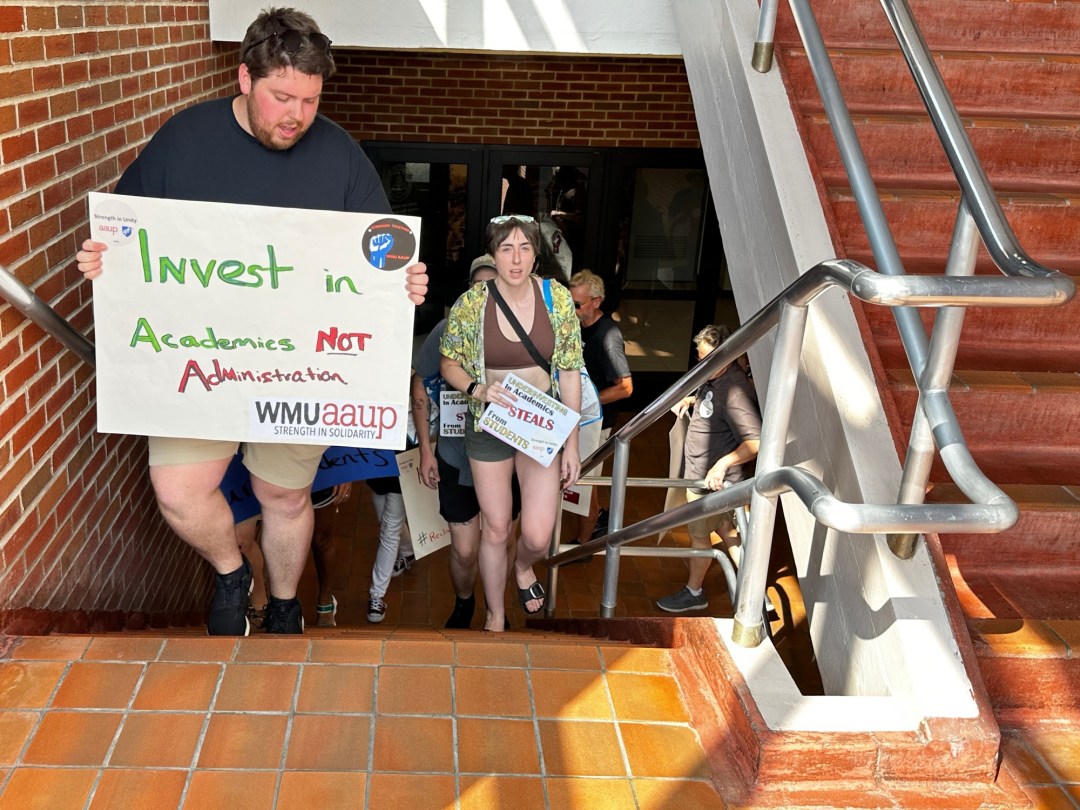
While the most dramatic story unfolding at Western Michigan University may be the ongoing negotiation battle between professors and the Administration—with the possibility of a strike and Vote of No Confidence still on the table—the context for the recent and ongoing unrest is actually much broader. After many years of what is coming to be known as a “disinvestment by the Administration in its core mission,” employees from across campus have shown up in force at protest rallies. As the president of WMU’s Chapter of the American Association of University Professors, Cathryn Bailey, put it: “Yes, my colleagues are battling for meaningful salary increases for professors, but this is also part of a larger fight to get Western to start investing in teaching and learning again. We’re advocating for ourselves, but also for our students’ education and the value of their WMU degrees.”
Against this backdrop, it may not be surprising that the “disinvestment” problem is being felt all over campus and in various ways. For example, graduate student Mel Robins (not his real name) shares that when he got his acceptance letter from Western Michigan University, he was thrilled. “I’d turned down much better financial packages from other schools because some of the best faculty in my field were at Western,” he says. Unfortunately, although Robins has loved working with his professors and student cohort, he quickly discovered chronic logistical challenges associated with his role as a teaching assistant, including shifting assignments, untenable teaching loads, and problems related to money owed to him by WMU, all of which were attributed by the Administration to its supposedly shrinking budget. “TAU (WMU’s Teaching Assistants Union) has been great, but I just can’t get over how uninterested the Administration seems to be in attracting and keeping its graduate students.”
According to TAU President Thomas Fisher, as negative as Robins’ experience has been, there’s been an even more worrisome reality unfolding behind the scenes at Western, what Fisher refers to as the Administration’s “fundamental and growing disrespect for its labor unions.” As Fisher puts it, “I’m talking about really basic things here: Administrators who treat employees like underlings or enemies [including at the negotiation table]” and “a knee jerk desire to escalate conflict rather than course correct when we point out contract violations.” Although Fisher is now one of WMU’s longest serving TAU presidents, he did not arrive in Kalamazoo planning to be a union activist graduate student. “The more I’ve seen of the Administration’s disinvestment in academics and its increasingly brazen disregard for its employee unions—including student workers—the more active and determined I have become,” he says.
As the Administration’s apparent anti-unionism has escalated, Western’s three academic unions, all now united under the powerful AFT umbrella (American Federation of Teachers), have been closely collaborating, both to diagnose and address the problem. Among the causes and symptoms they’re pointing to has been President Montgomery’s and Provost Vasquez Heilig’s commitment to use a notoriously anti-union, aggressive law firm to “deal with” its academic employees, including at the negotiation table. “We used to have an actual office of Academic Labor Relations on campus,” explains Tim Bober, president of WMU-PIO (Professional Instructors Organization). “It wasn’t perfect by any means, but at least there was someone there who understood academic values and didn’t just immediately try to beat us into submission.” And while, as a chronically underpaid, highly experienced WMU instructor, Bober has many concerns about the Administration’s priorities, its naked disdain for its own employees has taken a toll on him. “Basically, they treat us like we’re nothing,” he says.
All three of Western’s academic labor presidents point to WMU’s once-robust ALR (Academic Labor Relations) office to help explain the university’s burgeoning labor crisis. Now entering a second academic year led by an interim director for whom this is just one administrative gig among many, that office has become more of an obstacle than a place to resolve disputes. Bailey notes the “fundamental shift” that occurred when the Administration hired an external attorney a few years ago to direct its ALR office rather than appoint a faculty member as had always been the case. “Suddenly, we were forced to deal with aggressive professional attorneys right off the bat, with no reliable mechanism to resolve the kinds of issues that are just bound to come up on any campus.” As a result, Bailey explains, the WMU-AAUP has been forced to file a record number of grievances and arbitrations. “President Montgomery apparently has no limit when it comes to the student tuition dollars he’s willing to spend on anti-union attorneys,” Bailey says, estimating that “we may now be talking millions of dollars. And it’s obvious that the Administration is trying to force us to choose between protecting employees’ rights and expensive litigation.”
As compensation negotiations between WMU-AAUP employees and the Administration proceed past last Friday’s negotiation deadline, Bailey is not optimistic about the Administration’s willingness to make meaningful compromises at the table. “The WMU-AAUP’s team has already made significant compromises in its proposals, she explains, “while President Montgomery’s team has only come up by minuscule fractions after endless stonewalling and foot dragging.” At the same time, she says, she is “heartened” by the determination of colleagues in multiple employee groups urging the WMU-AAUP to continue fighting for as long as it takes.
“The fact that employees are increasingly willing to disrupt campus to draw attention to this problem tells you how urgent we think it is,” says Fisher. He adds somberly that “WMU’s reputation as a great place to learn and work can’t possibly survive if things continue as they have.”

 Strength in solidarity