
a negotiation message from WMU-AAUP president, Dr. Cathryn Bailey and vice president, Dr. Christopher Nagle
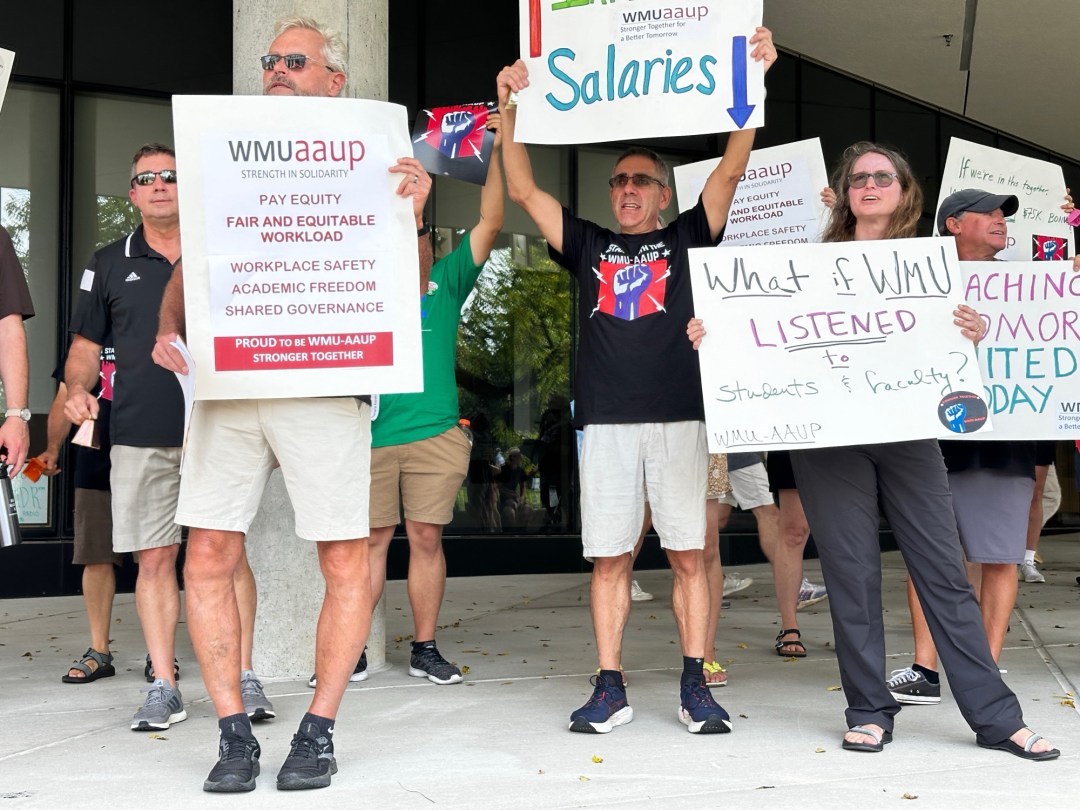
With wage-reopener negotiations between the Western Michigan University Administration and the WMU-American Association of University Professors now continuing on past the Friday deadline*, there’s another element to the compensation story that deserves attention. Because it lacks the drama of radically eroded salary figures, and because its impact is cumulative, this aspect of the university’s whittling away of employee income threatens to get lost in the shuffle.
But there is no better time to talk about the hidden, growing costs of simply doing one’s job as a professor—a trend rationalized at Western by its supposed “responsibility-centered,” SRM budget model—than during negotiations, and as the Western Administration implies that the faculty are greedy and out of touch. Many of us, however, are well aware that, when we are under-resourced—starved of supplies, travel funds, work space, equipment, and more—it effectively reduces our take-home pay and often negatively impacts students.
Here are a just a few examples:
⁃ the erosion and erratic supply of professional travel funds: professors, quite simply, need to travel to attend conferences, perform research, collaborate with other faculty, and the like. For most, this is necessary both to earn promotion and tenure, to develop students as scholars, and to remain competent in our fields and classrooms.
Nonetheless, although Western markets itself as a research-intensive university, it has spent tens of thousands of dollars this past year alone on legal fees to ensure that it has no concrete financial obligation in this area. This is, to be clear, merely one area in which WMU has been disinvesting in its research mission, but it is high on the list of nickel-and-diming, with numerous faculty reporting that they now pay out of pocket or have been forced to stop engaging in these baseline professional activities.
⁃ the chipping away at reimbursements for other sorts of professional travel, for example, between WMU regional sites for professional purposes related to teaching, research, or service. Increasingly, faculty are being told they must personally pay for fuel to teach a course at a satellite WMU campus or to come to Kalamazoo even to perform assigned work or service, including that which is necessary to directly support students.
⁃ a refusal by the university to supply necessary “work tools” in a reasonable fashion. To take one example, there have now been a number of reported cases where faculty have been expected to pay for their own work laptops or monitors because the equipment they had been assigned broke or wore out. In one case, a faculty member was stripped of network access—which she needed to teach her classes and communicate with students— when she failed to return a loaner machine on time after the university insisted that she pay for a new machine out of pocket.
In addition, there are reports of faculty being expected to buy lab supplies, safety wear, photocopies, awards for students, software, studio art space, and, with the near decimation of the library’s budget—access to journals and databases and books. One faculty member reported borrowing from a friend at Grand Valley State—not a research-intensive school, by the way—because our own research-intensive university claimed it couldn’t afford databases or books.
Again, these are just a few examples of how professional expenses are being shifted onto faculty. An ancillary expense has been that WMU’s disinvestment in students, both graduate and undergraduate, has created a situation in which employees across the university feel compelled to step up to fill in critical financial gaps. For example, our campus now abounds with stories of employees—in various employee groups—who have provided books, lodging, meals, and even emergency tuition payments for desperate students.
The fact that Western Michigan University has permanent charity opportunities for employees to fund students’ basic needs points to a normalization of the fact that the university now effectively expects employees to shore up such deficits. While faculty love our students, and such generosity is to be lauded and supported—indeed, we both participate— the institutional reliance on them further shifts the financial burden of supporting students from the university and onto employees. What does it say about Western Michigan University that it chooses to spend millions on its elite administrators, Division I football, fancy new buildings, and corporate attorneys and consultants, but accepts that food scarcity will be a basic condition for many of its students, both graduate and undergraduate?
We are perhaps all used to this sort of thing with respect to public school teachers, where radical political forces have long suggested that it is a favor to them to pay them at all—let alone to supply them with the supplies and continuing education they need to do their jobs—but this tendency has also been spilling over into higher education. And if third grade teachers can be painted as uppity for daring to request raises and money to buy glue sticks, of course it will be easy enough to portray university professors as selfish elitists.
Neither characterization is accurate, of course, but with the bully pulpit of institutional authority, communications, and PR smoke-screens to support them, the WMU Administration seems committed to justifying its “starvation-as-management” approach, according to which cutting away at expenditures is desirable regardless of the impact on key services or Western’s academic reputation. And while this chronic disinvestment in Western’s core mission is unlikely to make the news, it helps explain why so many employees are so frustrated and willing to fight on for as long as necessary.
*see Article 49, page 136 of the current WMU/WMU-AAUP Agreement
Got an experience to share about how professional expenses have been shifted onto you at Western? Reach out to staff@wmuaaup.net, or to the WMU-AAUP president or vice president.
to be notified of new posts by email, subscribe to this blog here
 Strength in solidarity